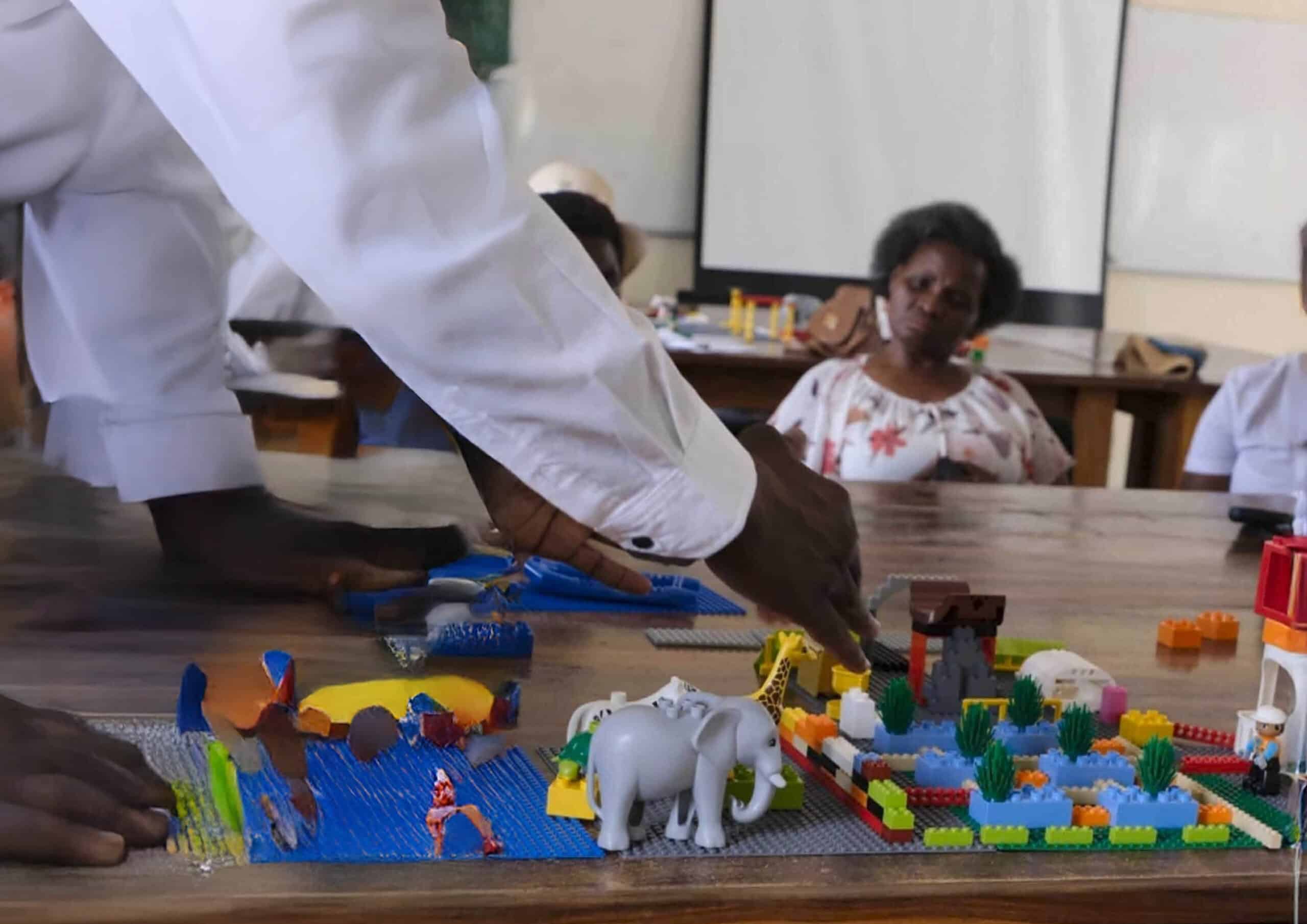
This study by Saymore Ngonidzashe Kativu (German Institute of Development and Sustainability, IDOS & Project B05 “Science Futures”), Glory Ernest Mella (Sokoine University), Castrow Muunda (Zambezi Horticultural Producers Association) and Anna-Katharina Hornidge (IDOS & Project B05 “Science Futures”) develops a novel, playful ethnographic methodology to explore future-making among marginalized communities, enabling participants to express their visions through artifacts and landscape-centered storytelling. By moving beyond standard questions, it captures how rural groups actively imagine and shape their futures within their socioecological contexts.
When Adults Play, Futures Unravel: Towards the Ethnography of Future-making Through Play-centric Methodology in Rural Africa
By Saymore Ngonidzashe Kativu (German Institute of Development and Sustainability, IDOS & Project B05 “Science Futures”), Glory Ernest Mella (Sokoine University), Castrow Muunda (Zambezi Horticultural Producers Association), Anna-Katharina Hornidge (IDOS & Project B05 “Science Futures”)
Abstract
As futures studies continue gaining prominence in the social sciences, questions arise about futuremaking methodologies, about how to solicit and comprehend societal aspirations, visions and actions with which individuals and communities make the future a subject of the present. Questions such as “What are your aspirations or visions for the future?” often entice inadequate responses within future-centric ethnographic studies. Drawing from sociology, environmental studies, the arts, and the disciplines of economics and geography, we depart in search of an ethnographic methodology with which to effectively solicit, organize and make sense of future-making by those at the margins. We combine artefacts and playfulness among adults to socially study futures. We draw empirically on two focus group discussions, a regular discussion workshop and three future-making workshops employing artefacts and participatory playful interactions in rural Tanzania and Namibia to propose a methodology towards succinct responses to difficult ethnographic questions about futures. These are questions outside the capacity for mundane responses, whose answers are rarely actively thought out by groups such as smallholder farmers and rural communities. Using the Lego Identity and Landscape Set (LILS) as utility artifacts for ethnographic inquiry, we outline a methodology enabling smallholder farmers to tell their stories of the future, as rooted in their evolving landscapes and, accordingly, their socioecological systems. A landscape-centric lens aids the understanding of the social-ecologies in which futures unravel. We highlight the methodology’s applicability outside the rural realm, generally towards ethnographies of futures, placing emphasis on the agency of marginalized groups.
Reference
Kativu, S. N., Mella, G. E., Muunda, C., & Hornidge, A. K. 2025. When Adults Play, Futures Unravel: Towards the ethnography of future-making through play-centric methodology in rural Africa. Futures, 103700. DOI