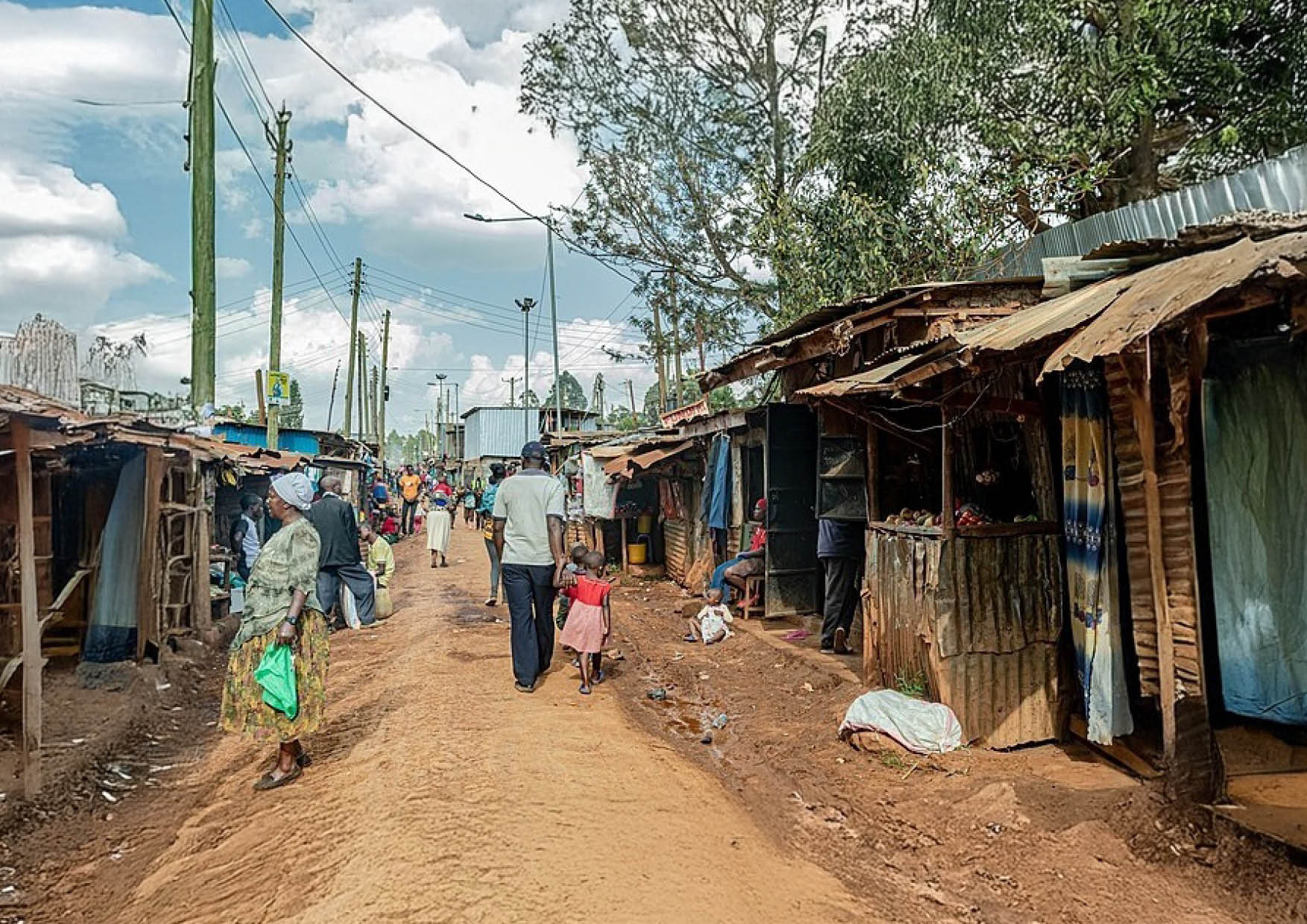
Valentine Opanga and Detlef Müller-Mahn (Project C03 “Green Futures”) examine how land cartels operate as powerful, embedded actors in Nairobi’s informal settlements, shaping land access, services, and urban development through hybrid formal–informal governance systems. Focusing on Korogocho, they argue that cartels are central to the city’s urban metabolism, blurring legality and informality through political performance and community legitimacy.
Cartel Economies and Urban Governance: The Interplay of Performative Politics, Social Embeddedness, and Land Control in Nairobi’s Informal Settlements
By Valentine Opanga and Detlef Müller-Mahn
Abstract
Land governance in Nairobi is shaped by hybrid systems that blur the boundaries between formality and informality, especially in informal settlements which houses over 60 per cent of the city’s population. Land cartels have emerged as powerful intermediaries, controlling access to land and services through “informal” channels. This article examines how cartels operate, sustain authority, and influence urban development in Korogocho, one of Nairobi’s largest informal settlements. Using a Critical Urban Political Ecology framework, the study reframes cartels as structurally embedded actors central to Nairobi’s urban metabolism. Based on a systematic literature review, 45 interviews, six focus group discussions, participatory mapping, and field observation, we find that cartels exploit both state tools and community legitimacy. Their power is rooted in long-standing relationships, trust, and entanglements that cast them as protectors and gatekeepers. Both they and officials engage in performative politics to mask systemic failures. These findings challenge legality/illegality binaries and call for rethinking governance through embedded informality and political performance.
Reference
Opanga, V., Müller-Mahn, D. 2026. Cartel Economies and Urban Governance: The Interplay of Performative Politics, Social Embeddedness, and Land Control in Nairobi’s Informal Settlements. Africa Spectrum, 0(0). DOI
Cover Image: By Ninanara, via Wikimedia Commons, licensed under CC BY-SA 4.0