



CRC TRR 228 Project Z04

Integrated Research and Training Group (IRTG)

Z04 Integrated Research and Training Group (IRTG)

Project Summary

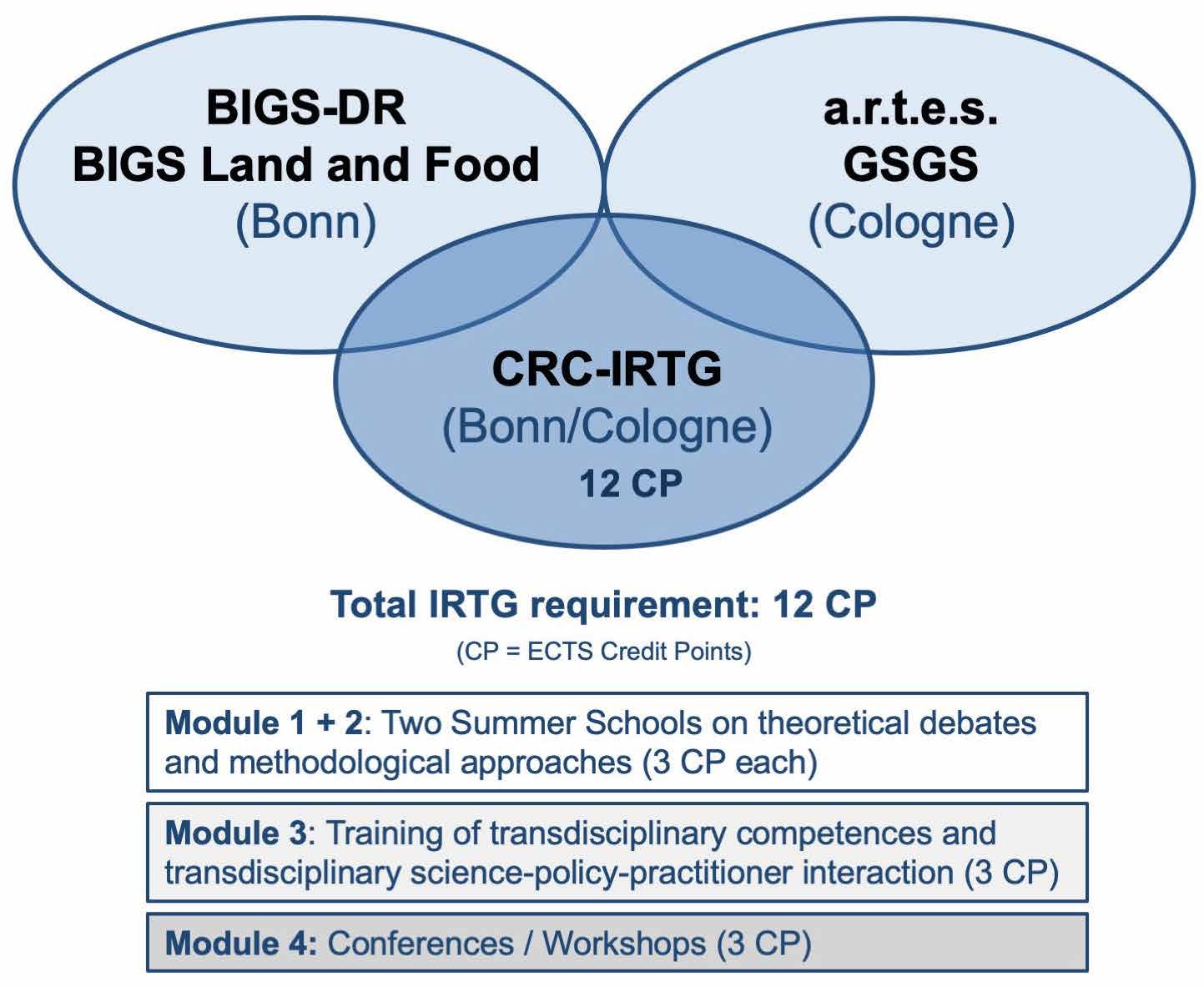
As in the prior two funding phases of the CRC, the proposed IRTG will build on existing PhD programmes at both partner universities, but complements them with a training programme that addresses the particular needs of the CRC. In the third phase this programme will be enhanced by a close-knit collaboration with the existing DAAD Global Climate and Environment Centre AFAS with its focus on MA and PhD education hosted at the UoB and UoC. Furthermore, we will expand our PhD students’ transdisciplinary perspective by exploring synergies with the organization of policy-dialogue activities by projects B03, B05 and B06 (see section “The way forward II: Synthesizing activities” in 1.2.2) and thus introduce them to science-policy-practitioner interaction. Over the last decade, a variety of structured doctoral programmes have been established at the universities of Bonn (UoB) and Cologne (UoC). The Bonn International Graduate School in Development Research (BIGS-DR) based at ZEF builds on a long tradition of graduate education in the context of development research, with many of its graduates focusing on the field of African Studies. Additionally, the BIGS Land and Food of UoB’s Faculty of Agricultural, Nutritional and Engineering Sciences (AEI) also provides a structured graduation context for PhDs working on topics related to agrarian questions in the Global South, particularly Africa. At the UoC, the a.r.t.e.s. graduate school serves as the educational basis for all doctoral students of the Faculty of the Humanities, supported by the German Excellence Initiative (until 2019) as well as the German Academic Exchange Service (DAAD). Furthermore, the Graduate School for Geosciences (GSGS) at the UoC offers a structured PhD programme. In all four schools, the interdisciplinarity and internationalization of academic research play a decisive role, so that they form an ideal institutional background for the graduate training of the CRC. Doctoral researchers of the CRC must join one of these graduate schools, but have the choice to join the graduate schools and the specialized classes at either one of the two universities according to their disciplinary specialization, needs and interest. In addition, to strengthen cohesion and to deepen exchanges with PhD students in collaborating institutions in Africa it remains crucial for the CRC to create structures that facilitate and foster exchange and discussion among all the early-career researchers (ECRs) involved in the project. For the IRTG, a number of mandatory modules amounting to 12 Credit Points (CP) have been developed in order to guarantee and encourage exchange between the CRC graduates, who will all be enrolled in either the BIGS-DR, BIGS Land and Food (both UoB), a.r.t.e.s. or GSGS (both UoC). The first two modules are designed as CRC summer schools and coordinated jointly by the PLs and postdocs of the CRC. They will provide ECRs with training to enhance their theoretical knowledge and jointly explore the conceptual potential of Future Studies, particularly in relation to the thematic focus of the CRC, and train a new generation of scholars transcending traditional disciplinary boundaries to understand, critically discuss, and handle diverse methodological approaches and respective formats of data generated across the divides between the social and natural sciences (Modules 1 and 2). With the third phase focusing on transdisciplinary science-policy-practitioner interaction we will add a further module to the IRTG’s programme that introduces to and reflects upon diverse transdisciplinary engagements and challenges and provides ECRs with transdisciplinary competences and options for engagement with the policy-dialogue activities (Module 3). As in the second phase, we continue to acknowledge and encourage the participation of the ECRs at external workshops and conferences, as well as the organization and reflection of CRC-related lecture series, workshops, and reading weeks (Module 4). General academic skills as well as transferable skills shall be addressed within the existing structured doctoral programmes. In this way, the IRTG will enhance the exchange and coherence within the highly interdisciplinary yet thematically focused CRC, while at the same time providing opportunities to strengthen disciplinary skills in the context of well-established programmes.

The proposed IRTG will build on existing PhD programs at both partner universities, but complements them with a training program that addresses the particular design and interests of the CRC. The IRTG will thus enhance the exchange and coherence within the interdisciplinary yet thematically focused CRC and provide opportunities for ECRs to strengthen disciplinary skills in the context of well-established programs.

The IRTG will be established during the first General Assembly of the CRC, where its statutes shall be approved by all members of the CRC. The IRTG shall include a student representative who will also be part of the executive board of the CRC. The scientific coordinator of the CRC will coordinate and assist in the organization of IRTG activities. PIs Borgemeister and Bollig will be responsible for coordinating the communication with and structural developments to BIGS-DR and a.r.t.e.s.

Module 1:

Provide ECRs with training to enhance their theoretical knowledge and jointly explore the conceptual potential of Future Studies, particularly in relation to the thematic focus of the CRC. (Summer School 2026*, Nairobi)


Module 2:

Train a new generation of scholars transcending disciplinary boundaries to understand, discuss, and handle diverse methodological approaches and respective formats of data generated across social and natural sciences. (Summer School 2027*,

Nairobi/Windhoek)


Module 3:

Encourage the participation of ECRs at external workshops and conferences as well as the organization and reflection of CRC-related lecture series, workshops and reading weeks. (Summer School 2028*,Bonn/Morogoro)


Module 4:

General academic and transferable skills to enhance ECRs’ employability across academic, industrial, public, and educational sectors will be covered within the existing structured doctoral programs. CPs may however also be obtained by the ECRs for organizing workshops themselves.


* The summer schools will be open to and actively involve ECRs from the partnering African universities.

1. Organising and hosting annual Summer Schools

2. Organization of regular trainings and workshops for ECRs on topics related to future making in rural Africa

3. Funding of study visits

Team Members

Michael Bollig Portrait

Prof. Dr. Michael Bollig

Project Leader

University of Cologne

Christian-Borgemeister-B02-Future-Infections

Prof. Dr. Christian Borgemeister

Project Leader

University of Bonn

Project News

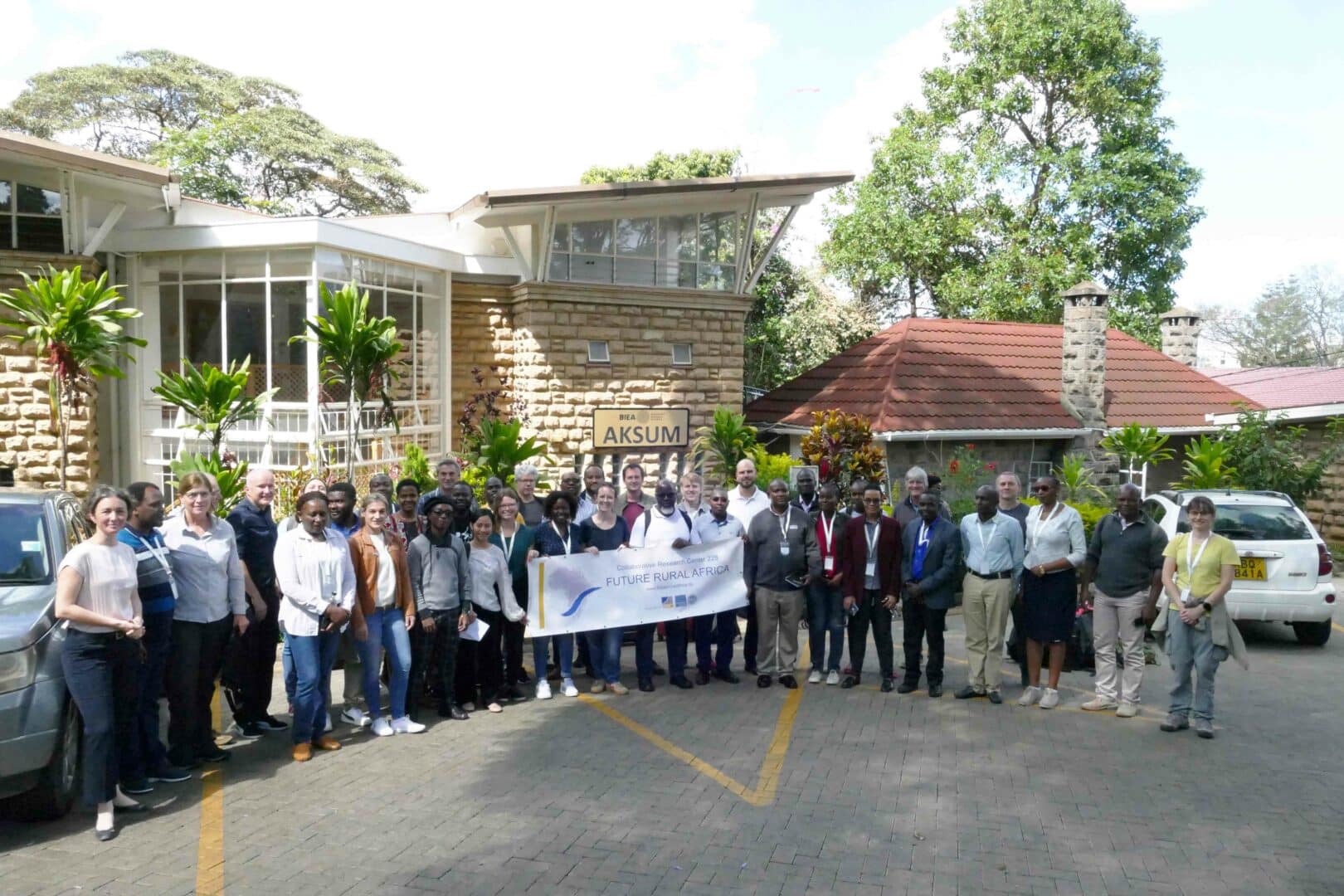
CRC group photo

Report: CRC-TRR 228 Future Rural Africa Summer School Kenya 2022

The Collaborative Research Center-TRR 228 Future Rural Africa conducted the Kick-Off event of the second funding phase and 2022 summer school in Nairobi and Naivasha ...
Read More »
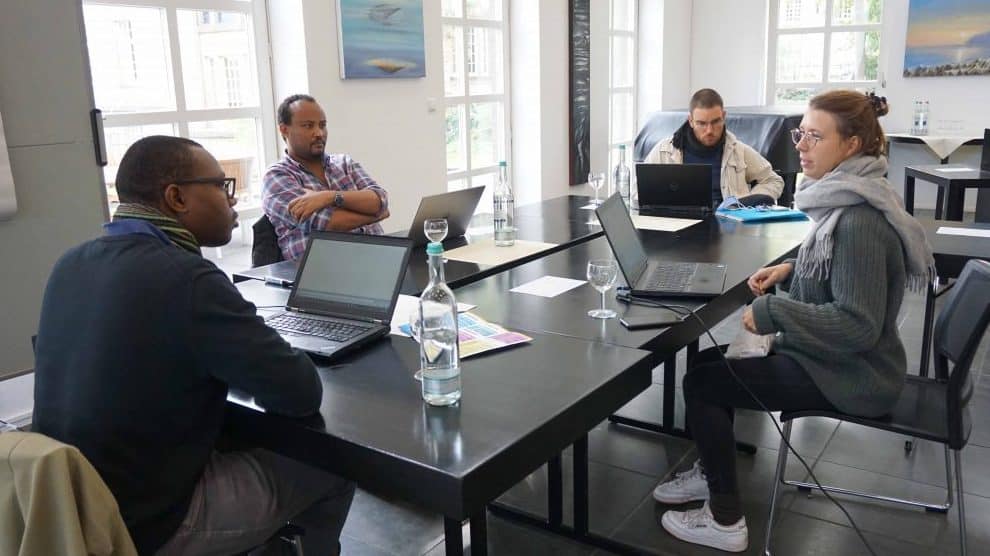
poster crc kick off and summer school in windhoek

Kick-Off 2nd Funding Phase & CRC Summer School 2022 Windhoek (19-23 September)

The kick-off event for the CRC’s second funding phase in Windhoek is around the corner. On Monday, 19 September 2022 participants from high ranking government ...
Read More »
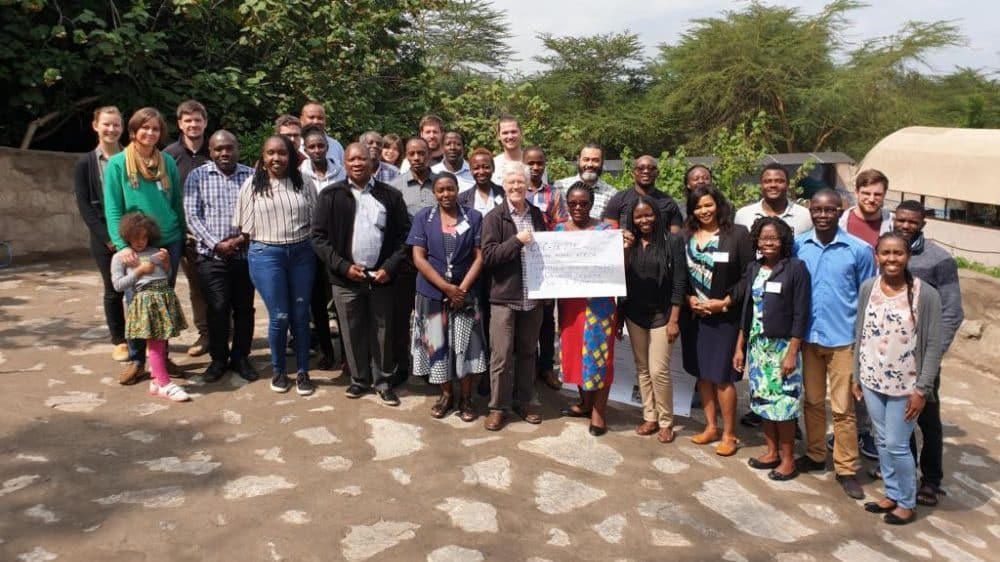
Early-career researchers in a group workshop during the CRC Summer School 2020.

Summer School 2020

African Rural Futures: Debates, Theories, and Challenges Rattled by the adverse effects of COVID-19, the year 2020 continues to exemplify the global phase unprecedented with ...
Read More »
Group photo of CRC members during summer school

Future Rural Africa Summer School 2019

The second annual CRC-TR 228: Future Rural Africa Summer School was held in Nairobi and Naivasha, Kenya from 29th July to 2nd August 2019 under ...
Read More »
Scroll to Top