Mon | June 15th, 2026 | 16:00 (CEST)
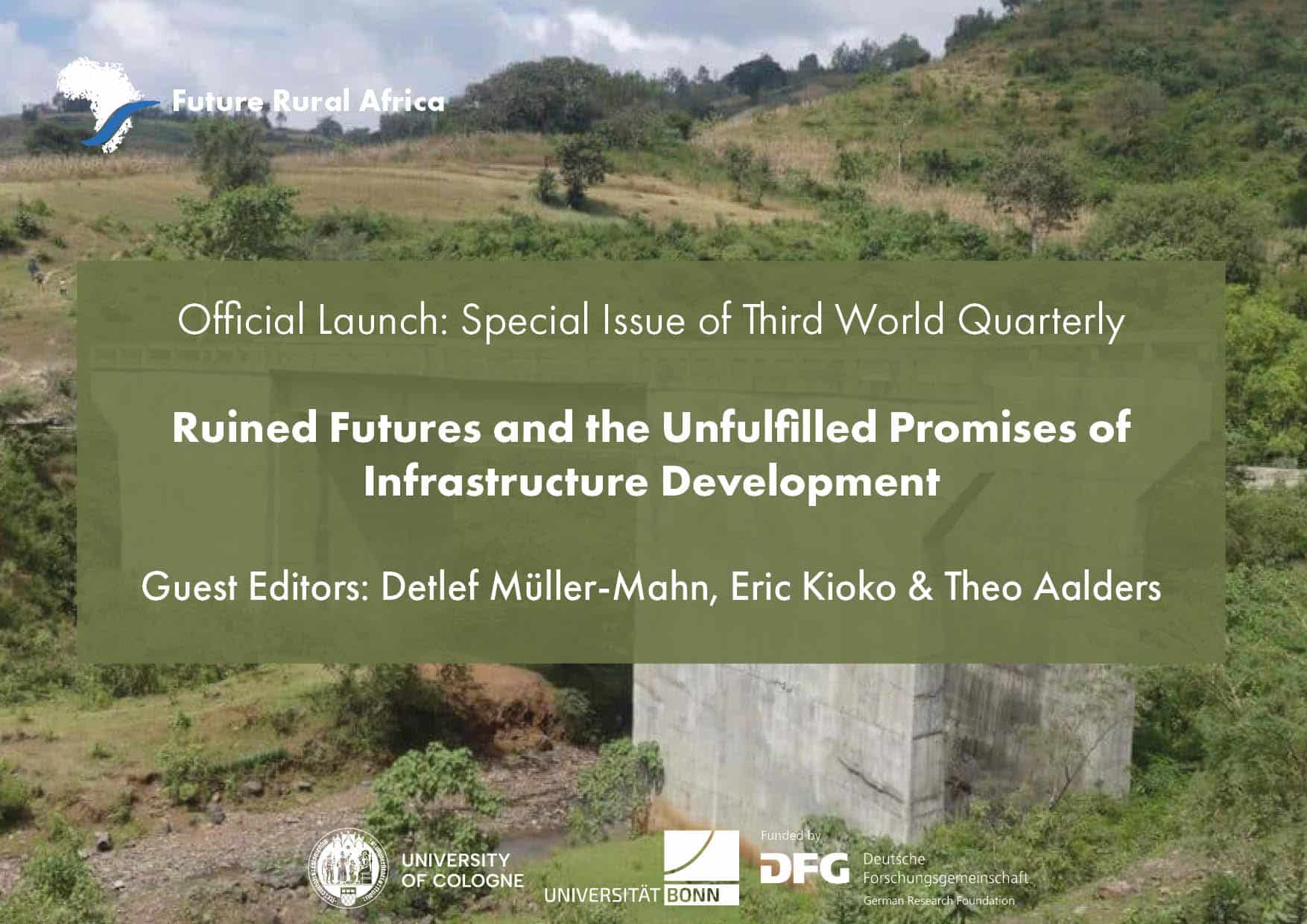
Guest-edited by Detlef Müller-Mahn, Eric Kioko and Theo Aalders from our sub-project C03 “Green Futures”, this special issue of Third World Quarterly explores “ghost projects,” or unfinished infrastructure developments whose lingering, half-present state continues to shape future development visions and practices. It defines the concept, distinguishes it from related ideas, and proposes a typology based on visibility, outcomes, and temporality. The volume features contributions from several Future Rural Africa researchers.
The launch of the special issue takes place on 15 June, 16:00-18:00 (CEST) and can be accessed through this link.
Abstract
Ghost projects are often overlooked, although they exist in all corners of the world, in the South as well as in the North: mega-dams whose construction was delayed for decades, unfinished urban developments, roads that exist only on maps, or abandoned airports. These unbuilt or incomplete infrastructure projects are not just harmless ruins. Rather, they reveal the broken promises of development. The twelve contributions to the special issue in Third World Quarterly on “Ghost Projects” provide evidence of the diversity of infrastructure projects that did not unfold as originally planned or promised. The case studies demonstrate that ghost projects are characterised by their inherent ambiguity. In their present-absence, they haunt the present through past imaginations and imagined futures, thus shaping the policies and practices of infrastructure development. This special issue was produced in the context of the Collaborative Research Centre ‘Future Rural Africa: Future Making and Social-Ecological Transformation’. The launch event consists of short (3 minutes each) presentations of the contributions, framed by a conceptual introduction and a discussant, followed by a discussion.
Reference
Müller-Mahn, D., Kioko, E., Aalders, T. (eds.) 2026. Ghost projects – ruined futures and the unfulfilled promises of infrastructure development. Third World Quarterly, Volume 47, 2026. DOI