Publication: Supplying Lead Firms, Intangible Assets and Power in Global Value Chains – Explaining Governance in the Fertilizer Chain

By Peter Dannenberg and Gideon Tups (CRC-TRR Project C01 Future in Chains / University of Cologne).

Abstract

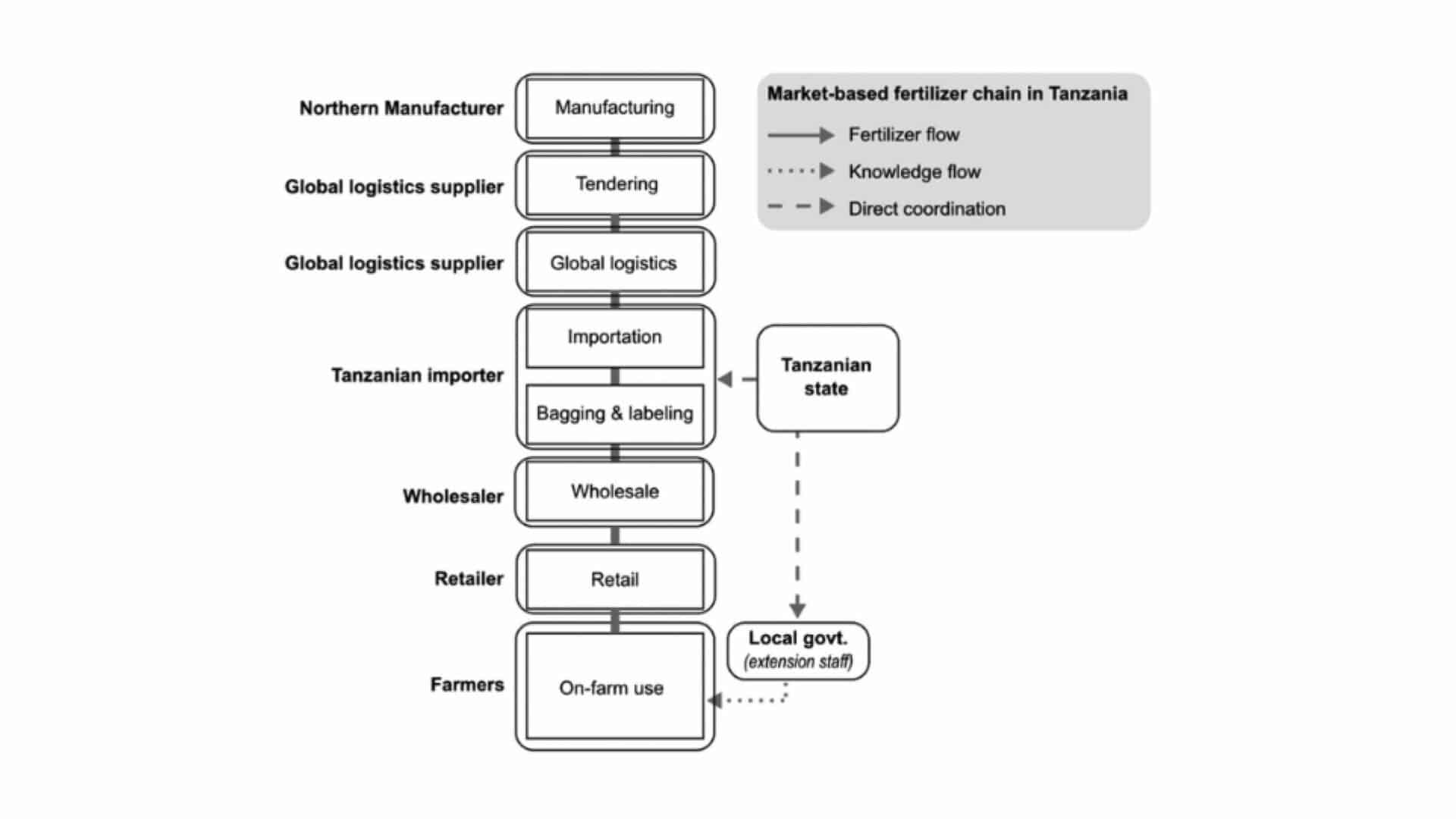
Global suppliers of agricultural inputs such as seeds, fertilizers and agrochemicals exert increasing degrees of power in global value chains (GVCs). Although the GVC literature has explained how global buyers govern GVCs from the buying-end, the question of how global suppliers achieve governance from the supplying-end remains underexplored. We address this gap by combining a multidimensional typology of power with literature on intangible assets. We argue that intangible assets are crucial resources for global suppliers to morph otherwise ungovernable supply chains for undifferentiated input commodities into more sophisticated and governable GVCs. We illustrate our argument with the case of the global fertilizer supplier, YARA International. YARA’s intangible asset investments were instrumental in governing the value chain integration of Tanzanian smallholder farmers. They allowed YARA to exert more than bargaining power (demonstrative, institutional and constitutive power) and to effectively position itself as supplying lead firm in Tanzania’s agro-industrial GVC.

Dannenberg, P., Tups, G. 2023. Supplying lead firms, intangible assets and power in global value chains: Explaining governance in the fertilizer chain. Global Networks. A Journal of Transnational Affairs. Full Text

For more information on project C01 Future in Chains click here.

More CRC News

cover for a web post

CRC-TRR 228 Future Rural Africa Awarded Funding for a Third Project Phase (2026-2029) by German Research Foundation (DFG)

We are thrilled to announce that the German Research Foundation (DFG) has awarded the Collaborative Research Centre TRR 228 Future Rural Africa funding for another ...
Read More »
image shows a field in eastern Africa

New Study Reveals How Tanzanian Farmers Navigate Conflicting Sustainability Worlds

Saymore Ngonidzashe Kativu (Project B05 “Science Futures”) argues that smallholder farmers in Mbeya, Tanzania navigate conflicting market-based and eco-cultural ideas of sustainability by creating hybrid farming ...
Read More »
the image shows an industrial area

New Publication: How State Strategies in Special Economic Zones Shape Labor Outcomes in Ethiopia and Zambia

Carolina Kiesel and Peter Dannenberg (Project C01 “Future in Chains”) analyse how different state strategies for developing Special Economic Zones (SEZs) shape labour outcomes. Comparing ...
Read More »
a map showing the location of nyerere dam in Tanzania

Reviving a Ghost Dam: The Politics and Promise of Tanzania’s Rufiji River Basin

In this newly published article, Emma Minja and Detlef Müller-Mahn (Project C03 Green Futures) explore the century-long history and politics of the Stiegler’s Gorge (now ...
Read More »
book cover of a publciation about foot and mouth disease

Rethinking Foot-and-Mouth Disease: How Botswana’s History Challenges Colonial Views of Animal Health

This publication examines how understandings of foot-and-mouth disease (FMD) in Botswana during the 1960s–70s were shaped by colonial and postcolonial contexts, showing how local veterinary ...
Read More »
Scroll to Top