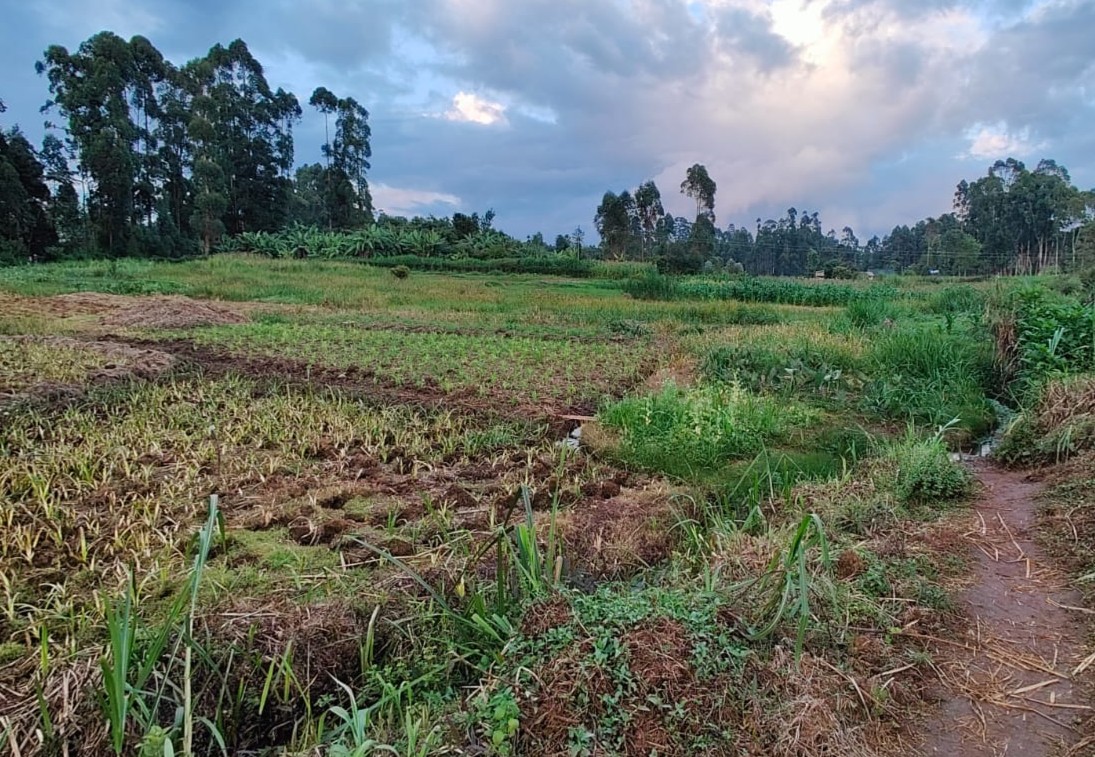
Saymore Ngonidzashe Kativu (Project B05 “Science Futures”) argues that smallholder farmers in Mbeya, Tanzania navigate conflicting market-based and eco-cultural ideas of sustainability by creating hybrid farming strategies and meanings. He shows how these farmers reconcile competing knowledge systems—often emotionally and cognitively—revealing sustainability as a plural, negotiated, and context-specific process rather than a universal model.
Standing on shifting ground: Epistemological contradictions between markets and eco-cultural values of sustainability in smallholder farming in Mbeya, Tanzania
By Saymore Ngonidzashe Kativu (Project B05 “Science Futures”).
Abstract
This research explores how epistemological dissonance shapes agrarian sustainabilities in Mbeya, Tanzania. Through a case study of smallholder farmers navigating both market-driven and eco-cultural paradigms of sustainability, the research explores how plural epistemologies shape local sensemaking and agricultural decision-making. It demonstrates how farmers reconcile divergent sustainability logics, those rooted in market interpretations of sustainability with those rooted in relational ethics, ecological stewardship, and cultural continuity within agrarian landscapes. Employing hybrid strategies, farmers compartmentalize production, input intensive, market-targeting monocultures co-exist alongside primarily subsistence agroecological systems. These spatial divisions mirror deeper ontological tensions, as farmers articulate pride in market breakthroughs while expressing anxiety about environmental degradation, cultural erosion, and the loss of intergenerational practices. Building on plural sustainabilities literature and epistemologies of the South theories, the paper adds to scholarship reinterpreting sustainability not as a universal, singular paradigm, but a contested, contextually negotiated process. The case of Mbeya illustrates how epistemological dissonance becomes embodied through emotional and cognitive labor, and how hybrid sensemaking enables farmers to navigate conflicting knowledge systems. Rather than viewing hybridity as incoherence, the paper interprets these strategies as acts of situated resilience, adaptation, and resistance. The analysis contributes to political ecology and sustainability studies by foregrounding the ontological multiplicity at play in agrarian transitions and calls for institutional recognition of knowledge pluralism. Ultimately, the paper proposes a shift toward pluriversal sustainability frameworks that integrate both empirical and relational epistemologies, acknowledging that sustainable futures are as much about values and worldviews as they are about technologies and yields.
Reference
Kativu, S., N., Standing on shifting ground: Epistemological contradictions between markets and eco-cultural values of sustainability in smallholder farming in Mbeya, Tanzania, Current Research in Environmental Sustainability, Volume 10, 2025, 100322, DOI