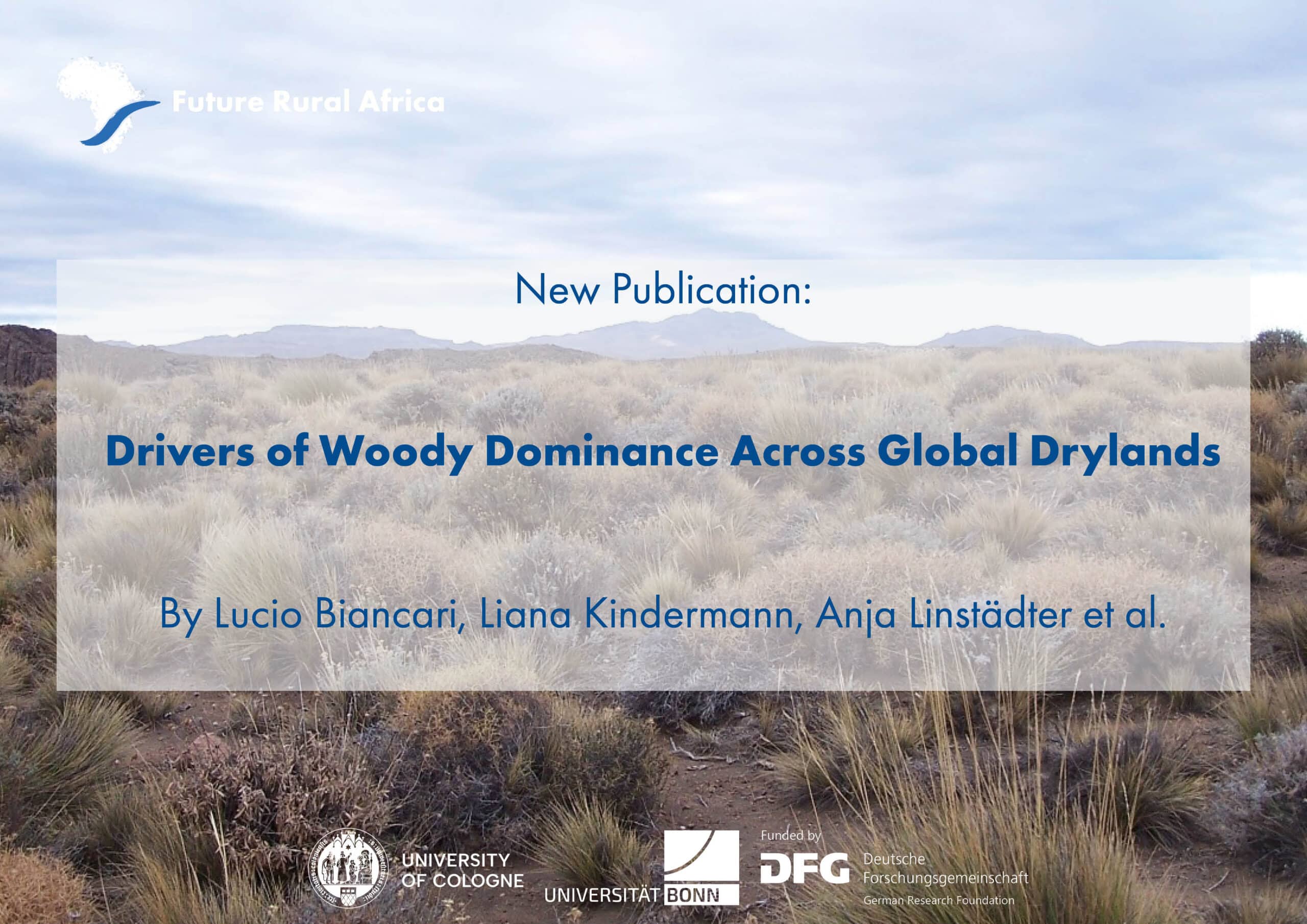
New Publication: Drivers of Woody Dominance Across Global Drylands

By Lucio Biancari (Universidad de Buenos Aires),Liana Kindermann (Project A01 Future Carbon Storage), Anja Linstädter (Project A01 Future Carbon Storage) et al.

Abstract

Increases in the abundance of woody species have been reported to affect the provisioning of ecosystem services in drylands worldwide. However, it is virtually unknown how multiple biotic and abiotic drivers, such as climate, grazing, and fire, interact to determine woody dominance across global drylands. We conducted a standardized field survey in 304 plots across 25 countries to assess how climatic features, soil properties, grazing, and fire affect woody dominance in dryland rangelands. Precipitation, temperature, and grazing were key determinants of tree and shrub dominance. The effects of grazing were determined not solely by grazing pressure but also by the dominant livestock species. Interactions between soil, climate, and grazing and differences in responses to these factors between trees and shrubs were key to understanding changes in woody dominance. Our findings suggest that projected changes in climate and grazing pressure may increase woody dominance in drylands, altering their structure and functioning.


Reference

Biancari, L., Kindermann, L., Linstädter, A. et al. 2024. Drivers of woody dominance across global drylands. Science Advances, Volume 10 (41), DOI


Image: María Valeria Aramayo. Pilcaniyeu, Argentina.
More CRC News

cover for a web post

Online Workshop: Commitment, Courage, Curiosity: How to be(come) an Inclusive Leader

On November 7 and 14, 2025, the Board for Gender Equality and Diversity hosted the online workshop “Commitment, Courage, Curiosity: How to be(come) an Inclusive ...
Read More »
a researcher drilling a hole in a tree with a manual drill

Wood Density Varies More Within Species than Previously Recognized, Global Analysis Shows

Wood density is an important plant functional trait to understand how trees everywhere in the world grow, compete with each other, persist or are affected ...
Read More »
kibagare area in nairobi, kenya

Power, Land, and Informality: How Cartels Shape Governance and Urban Life in Nairobi’s Informal Settlements

Valentine Opanga and Detlef Müller-Mahn (Project C03 “Green Futures”) examine how land cartels operate as powerful, embedded actors in Nairobi’s informal settlements, shaping land access, ...
Read More »
cover for a web post

New Publication: The Politics of Suspended Infrastructure in Kenya

Uroš Kovač (Project B04 “Framing Futures”) examines stalled construction projects in Kenya—focusing on the suspended renovation of Kamariny Stadium—to show how “suspension” functions as a ...
Read More »
logo of the cologne international forum

Cologne International Forum Grants: Innovative Tandem Collaborations

The University of Cologne will be awarding five project grants (€ 15,000 each) annually for project-related innovative tandem collaborations between University of Cologne-based academics and ...
Read More »
Scroll to Top