Hunting, Environmental Change, and the Defaunation of Wildlife in Baringo, Kenya (1840–1977)

Hauke-Peter Vehrs (Project A04 “Future Conservation”) and David Anderson (Project A02 “Past Futures”) argue that the sharp decline of wildlife in Kenya’s Baringo region during the first half of the 20th century was caused mainly by intensive hunting by European settlers and sports hunters, along with colonial-era land-use changes—not by local hunters or poaching. They also challenge the idea that colonial conservation policies effectively protected wildlife, showing that conservation rhetoric often failed to prevent habitat loss and overhunting.


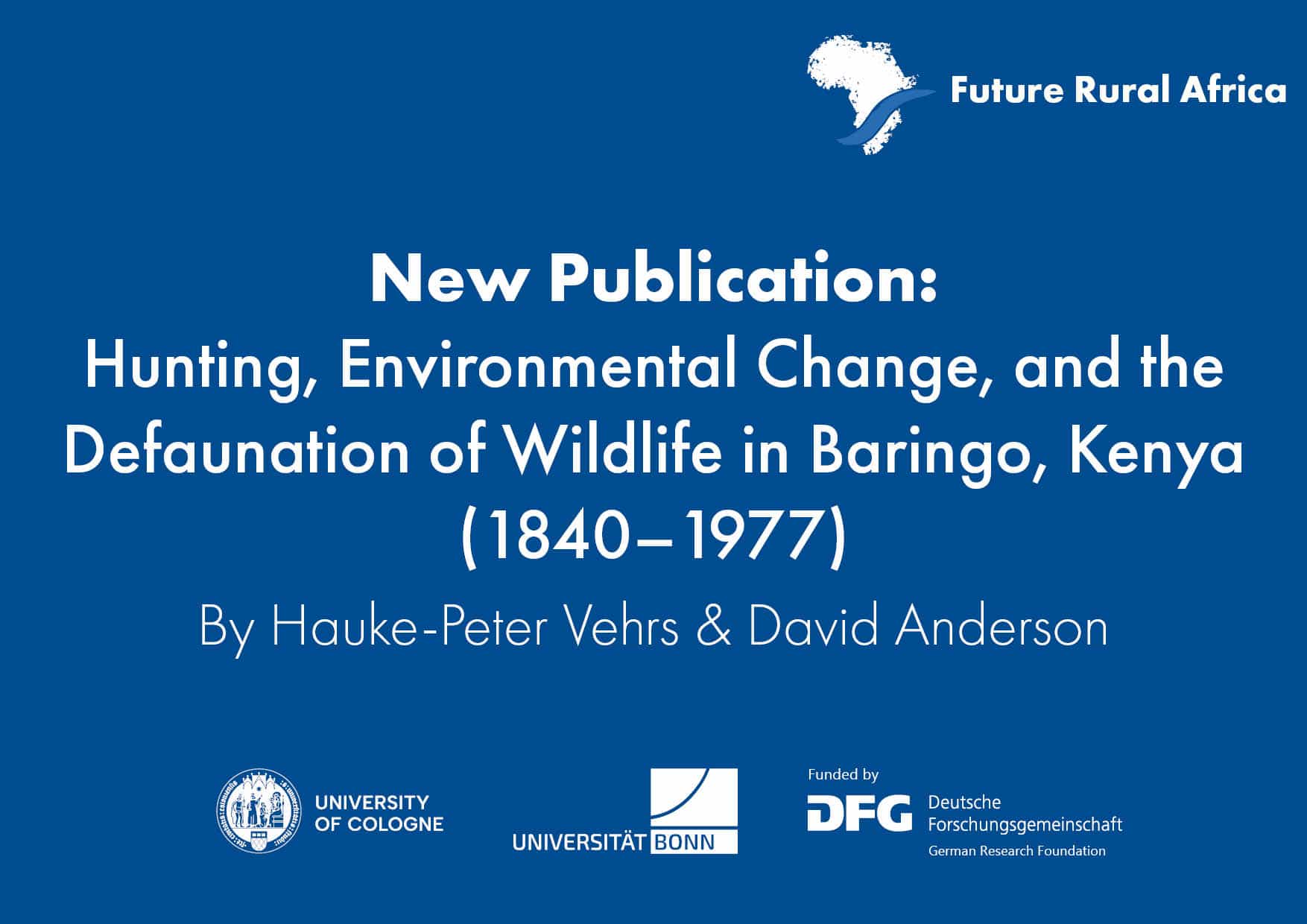
Hunting, Environmental Change, and the Defaunation of Wildlife in Baringo, Kenya (1840–1977)

By Hauke-Peter Vehrs and David M. Anderson

Abstract
This article takes a long-term view of the history of Kenya’s wildlife, to consider the gradual defaunation of wildlife that took place over the first half of the twentieth century. In the Baringo lowlands of Kenya’s northern Rift Valley, a district famous for ivory hunting in the nineteenth century and an area with a dense wildlife population, the depletion of Kenya’s wildlife populations was not the result of hunting by locals or increased poaching, but rather the product of intensified hunting by white settlers and licensed sportsmen from the end of the nineteenth century through the 1950s, combined with major changes in land use brought about under colonial rule from the 1920s. Despite Kenya’s colonial rhetoric of conservation, Baringo (and many other locations like it) was never protected from the predations of hunters or the impact of land consolidation.


Reference

Vehrs, H.P., Anderson, D. 2026. Hunting, Environmental Change, and the Defaunation of Wildlife in Baringo, Kenya (1840–1977). Environmental History, Volume 31 (2), DOI

More CRC News

group of people posing for a group picture during a workshop

Workshop: Turning the Illiberal into the Convivial? Debating the Future of Wildlife Conservation in Africa

June 7th – 9th, 2026 | Cape Town Turning the Illiberal into the Convivial? Debating the Future of Wildlife Conservation in Africa This workshop critically ...
Read More »
cover for a web post

Ghost Projects – Ruined Futures and the Unfulfilled Promises of Infrastructure Development: Launch of Special Issue of Third World Quarterly (Online)

Mon | June 15th, 2026 | 16:00 (CEST) Guest-edited by Detlef Müller-Mahn, Eric Kioko and Theo Aalders from our sub-project C03 “Green Futures”, this special ...
Read More »
cover for a web post

Call for Applications: PhD Scholarship – Violent Futures? Contestations Along Carbon Frontiers in East Africa

Our Subproject B03 “Violent Futures” is currently accepting applications for a PhD scholarship position. The project examines how future-oriented carbon credit projects shape social relations ...
Read More »
logo of jkuat

Call for Applications: JKUAT Summer School on Transdisciplinary Methods for Studying Social-Ecological Systems

With funding from the Volkswagen Foundation, the Jomo Kenyatta University of Agriculture and Technology (JKUAT) in Kenya in collaboration with the Research Unit on Agro-Pastoral, ...
Read More »
cover for a web post

Vereinbarkeitswoche 2026: „Zwischen Anspruch und Alltag – Wege zur Vereinbarkeit“ [DE]

Mit der gemeinsamen Vereinbarkeitswoche „Zwischen Anspruch und Alltag – Wege zur Vereinbarkeit“ realisiert das HochschulNetzwerk Familie (HNF) NRW erstmals ein institutionsübergreifendes Veranstaltungsformat für alle Studierenden ...
Read More »
Scroll to Top