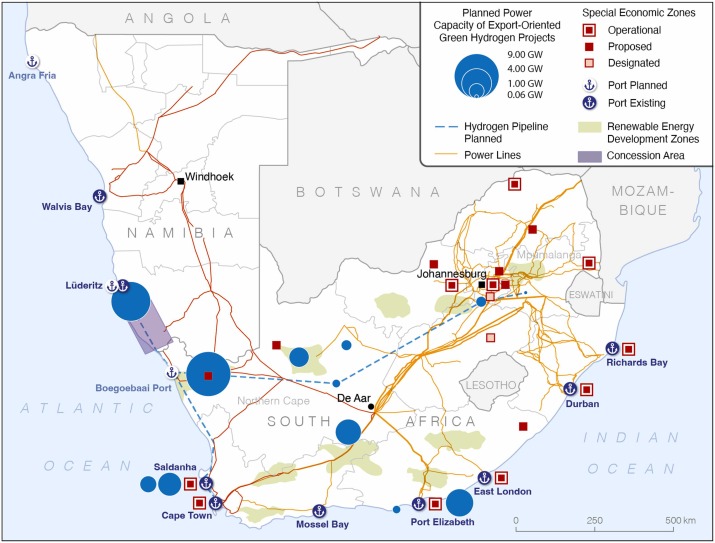
In their publication, Benedikt Walker and Britta Klagge (Project C02 Energy Futures) alongside Ravn Haid (University of Bonn) examine how spatial planning influences the development of export-oriented green hydrogen projects (EOGH2Ps) in Chile, Namibia, and South Africa. Using planning documents and expert interviews, they compare each country’s approach—Namibia’s restrictive, South Africa’s facilitative, and Chile’s shift from market-based to restrictive. Their study highlights how these differing planning strategies shape project outcomes, including scale, infrastructure use, environmental impacts, and public acceptance, emphasizing the importance of deliberate spatial planning in guiding green hydrogen development.
Spatial planning policies for export-oriented green-hydrogen projects in Chile, Namibia, and South Africa
By Benedikt Walker, Britta Klagge and Ravn Haid
Abstract
Export-oriented green-hydrogen projects (EOGH2P) are being developed in regions with optimal renewable-energy resources. Their reliance on economies of scale makes them land-intensive and object of spatial planning policies. However, the impact of spatial planning on the development of EOGH2P remains underexplored. Drawing on the spatial planning and megaproject literatures, the analysis of planning documents and expert interviews, this paper analyzes how spatial planning influences the development of EOGH2P in Chile, Namibia, and South Africa. The three countries have developed different spatial planning approaches for EOGH2Ps and are analyzed by employing a comparative case-study design. Our findings reveal that Namibia pursues a restrictive approach, South Africa a facilitative approach, whereas Chile is shifting from a market-based to a restrictive approach. The respective approaches reflect different political priorities and stakeholder interests and imply diverse effects on the development of EOGH2Ps in terms of their number, size, shared infrastructure, socio-environmental impact and acceptance. This study underscores the need for well-designed spatial planning frameworks and provides insights for planners and stakeholders on their potential effects.
Reference
Walker, B., Klagge, B., Haid, R. 2025.Spatial planning policies for export-oriented green-hydrogen projects in Chile, Namibia, and South Africa. Land Use Policy,
Volume 157, 2025, 107672, DOI