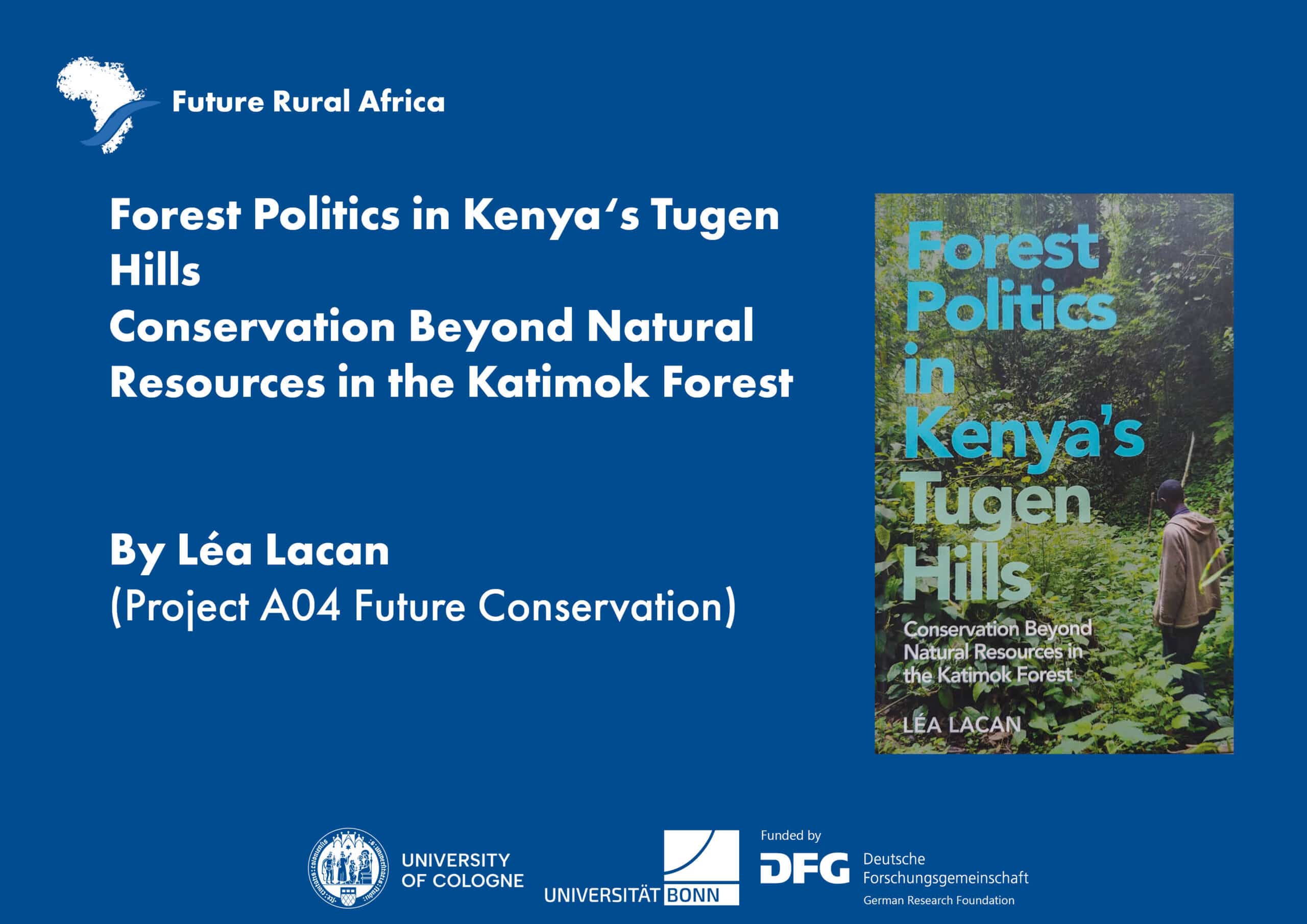
Researcher Léa Lacan, Project A04 Future Conservation, recently published the findings of her research conducted as a member of the Collaborative Research Centre Future Rural Africa. Her book “Forest Politics in Kenya’s Tugen Hills: Conservation Beyond Natural Resources in the Katimok Forest” by Boydell & Brewer is part of the Future Rural Africa Book Series. The official book launch is currently being planned. It will take place at the British Institute in Eastern Africa (BIEA) in September 2024.
Abstract
Forests are a changing environment, impacted as much by people and politics as by the species-rich diversity they contain. This book explores human-sylvan relations in the Katimok forest, Baringo highlands, Kenya, and asks us to rethink the forest beyond questions of access and control of natural resources, as a habitat where forest politics and human lives are inextricably intertwined.Tracing the development of the Katimok forest from colonial times to the present day, the author shows how – as with many forests in Africa – it has become constructed as a category and territory of nature under state control: an area both to be protected and turned into exploitable resources. For those living within and on the boundaries of the forest, this social-ecological transformation has had a significant impact. Despite now being settled outside Katimok itself, dispossessed by administrators heedless of local management practices, many former residents continue to maintain a close connection with the forest, not only to sustain their livelihoods, but also to maintain their intimate links with ancestral lands, where their stories and memories are materially inscribed and powerfully invoked. Intimate connections to the forest are revealed to be as political as the use of its resources, culminating in local claims for redress of historical dispossessions.
Tracing the development of the Katimok forest from colonial times to the present day, the author shows how – as with many forests in Africa – it has become constructed as a category and territory of nature under state control: an area both to be protected and turned into exploitable resources. For those living within and on the boundaries of the forest, this social-ecological transformation has had a significant impact. Despite now being settled outside Katimok itself, dispossessed by administrators heedless of local management practices, many former residents continue to maintain a close connection with the forest, not only to sustain their livelihoods, but also to maintain their intimate links with ancestral lands, where their stories and memories are materially inscribed and powerfully invoked. Intimate connections to the forest are revealed to be as political as the use of its resources, culminating in local claims for redress of historical dispossessions.
Reference
Lacan, L. 2024. Forest Politics in Kenya’s Tugen Hills. Conservation Beyond Natural Resources in the Katimok Forest. Boydell & Brewer, Woodbridge. Link