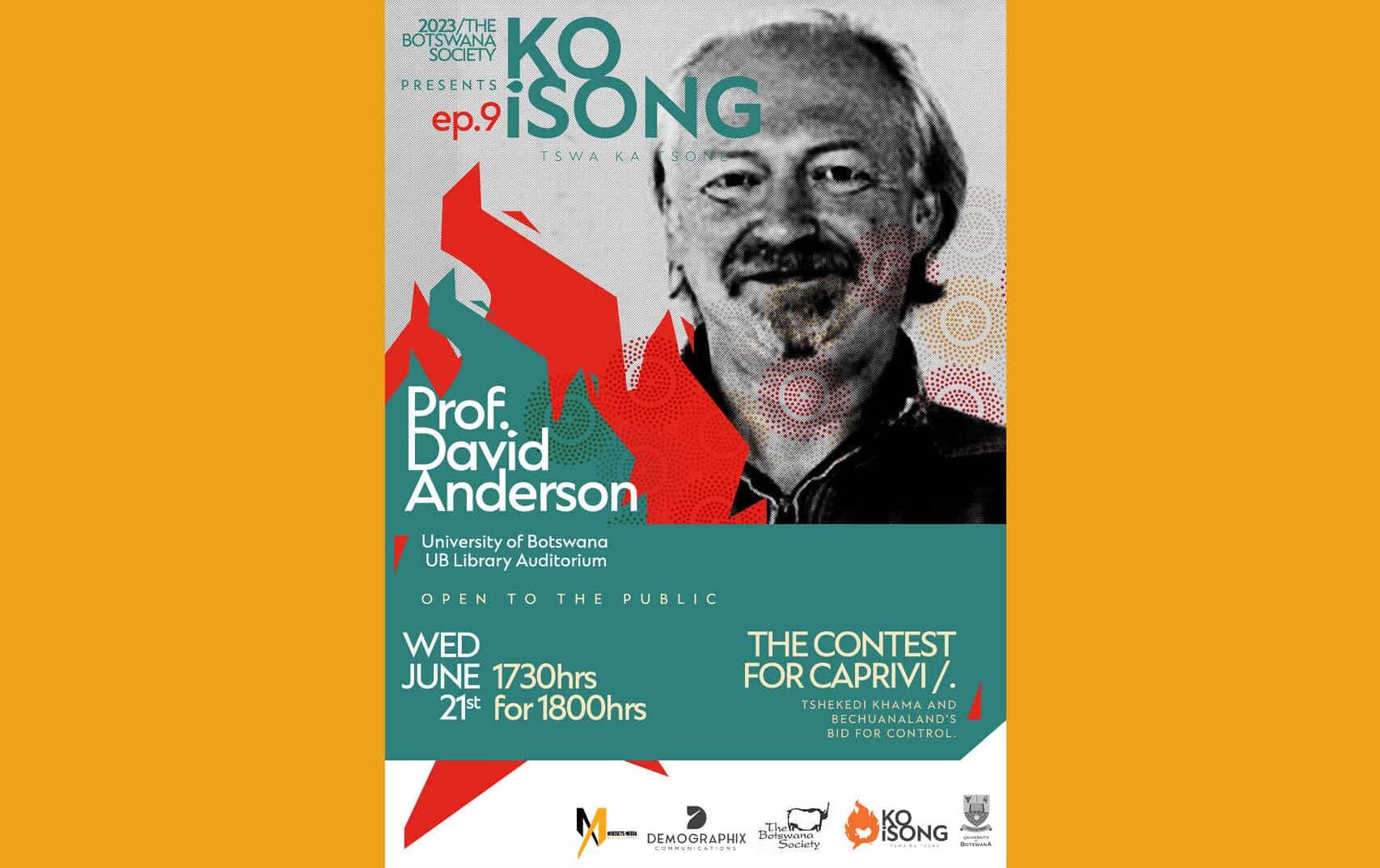
Wed | June 21, 2023 | 17:30 CEST
Join us for 9th episode of Ko Isong public lecture organised by The Botswana Society:
Click here for the full video.
David Anderson, Project A02 Past Futures:
The contest for Caprivi: Tshekedi Khama & Bechuanaland’s Bid for Control
Created by a treaty between the Imperial powers Germany and Great Britain in 1890, the so-called ‘Caprivi Strip’ is the worst and most bitterly contested of all of Africa’s many historical border problems 0f the colonial era. In the closing two decades of the nineteenth century, the politics of ‘claim-making’ swirled around the northern borderlands of the territory that would become Bechuanaland. Boer trekkers, raiding African kingdoms, the avaricious imperial powers of Germany, Britain and Portugal, and even Cecil Rhodes himself, competed to carve up the map into mineral rights and settlement claims, ‘spheres of influence’, ‘protectorates’, and ultimately colonies. The geographic and political oddity that became Caprivi was carved out of the fraught politics of this colonial claim-making, a game in which the African kingdoms of the Batawana, Ndebele, and Lozi played their part. Once created, Caprivi’s sovereignty became deeply contested, as German control gave way in the First World War to British administration – based at Maun, in Ngamiland – that was governed by a League of Nations Mandate. Administered by Bechuanaland until 1929, Caprivi was then transferred to Pretoria, and remained under South African control – in various forms – until 1990 saw Namibia’s independence under UN-organised transition. But from 1948 until 1966, the African rulers of Bechuanaland did their best to disrupt South African imperial claims upon Caprivi, making proposals for the transfer of the territory to Bechuanaland, and even in one grand gesture of imperial ambition, suggesting that Bechuanaland and Namibia (then South West Africa) should be unified into a single state. This lecture will map out this contested history in and over Caprivi, highlighting the little-known story of Bechuanaland’s attempts to claim Caprivi for its own.
Venue: University of Botswana Library Auditorium, Gaborone.
Click here to register for (in-person) attendance:
Check the Botswana Society Facebook Page for a link to livestream the event (link will be posted shortly before the event).