CRC TRR 228 Project C01
Future in Chains
Socio-economic impacts of growth corridors
C01 Future in Chains
Vision
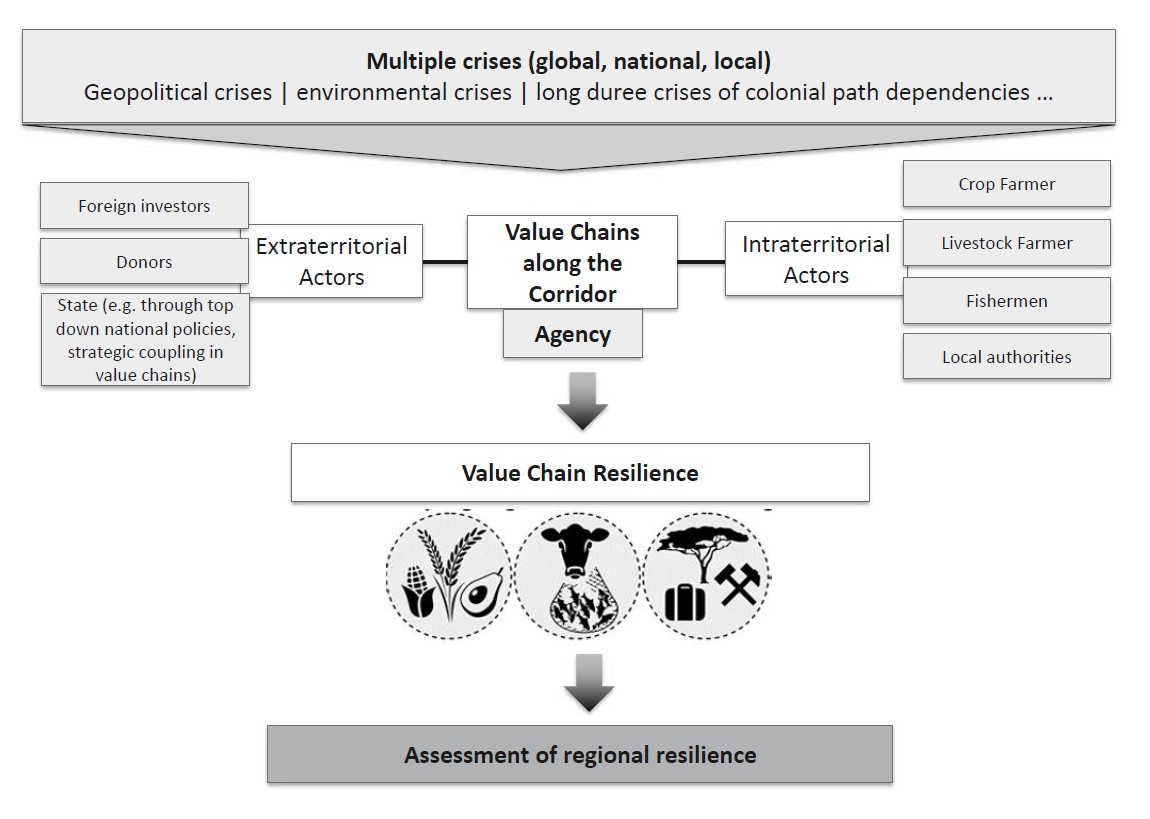
Explain impacts of multiple crises, response strategies and their implications on regional resilience from a Southern perspective to deepen our understanding of future-making along growth corridors.
Project Summary
Against the background of these overlapping challenges, our third research phase adopts a resilience-focused approach, examining multifaceted responses from various actors to impacts generated by intersecting challenges, disruptions, and long-duration crises at multiple scales. This will enable us to understand short-term adaptation and long-term adaptability (Neise, Revilla Diez and Garschagen, 2018), which is inherently linked to future-making. In the face of growing risks and uncertainties, building regional resilience and preparing the region for future crises is a crucial and necessary way of actively shaping the future. Therefore, we will expand our conceptual framework on corridor and value-chain analysis, integrating insights from local and geopolitical dynamics, cross-border interactions, and regional (meaning the sub-national scale) resilience. Our research will address three research questions that are critical to exploring pathways to resilient future-making: (a) how multiple, intersecting crises affect value chains along the two selected growth corridors, (b) which capacities and strategies different stakeholders (local, regional, national, global) implement to cope, adopt or even transform with these crises and why, and (c) how these strategies influence regional resilience. This includes exploring stakeholder agency and assessing how shifts in policy regimes, domestic investments, and international financial flows affect value chains from both top-down and bottom-up processes. A key advancement will be using survey data from the first two phases to trace developments since 2019 and explore emerging future paths aligned with the CRC’s future-making perspective. Continuing with a comparative approach across both regions, this dynamic method will deepen our understanding of future-making amidst multiple crises from a Southern perspective.
Research Regions: Namibia, Tanzania, Kenya
Problem Statement
The results of the first two phases indicate that, due to structural challenges and colonial continuities, neither of the two growth corridors – that is, the Southern Agricultural Growth Corridor of Tanzania (SAGCOT) and the Walvis-Bay Ndola Lubumbashi Development Corridor (WBNLDC) – has fully yielded the anticipated economic benefits. Moreover, these limited benefits face growing risks from global and regional crises. These include economic, social, (geo)political, and environmental crises, as well as COVID-19, and Russia’s invasion of Ukraine – which intersect with regional issues like colonial path dependencies and weather extremes. Such overlapping challenges severely affect the corridors’ value chains and, consequently regional development trajectories and future-making.
Key Questions for 3rd Phase
- How do multiple and intersecting crises impact value chains along development corridors?
- What are the strategies of different regional and external actors in changing landscapes (economic, political, environmental), with what intentions, and how do these strategies impact the value chains?
- How do the different identified strategies influence regional resilience?
Methods
CRC household survey, interviews & focus group discussions (crises impact, responses, implications), regional stakeholder workshops, secondary data
Key Findings from Phase II
Structural challenges and colonial legacies have hindered the economic benefits of the Southern Agricultural Growth Corridor of Tanzania (SAGCOT) and the Walvis Bay-Ndola-Lubumbashi Development Corridor (WBNLDC). Global and regional crises, including economic instability, geopolitical conflicts, and climate extremes, further exacerbate these limitations. In SAGCOT, local actors engage differently across value chains—for example, while Chinese markets are crucial for avocado farmers, soybean producers see them as optional. More broadly, African agriculture is continuously shaped by negotiations among farmers, governments, businesses, and international organisations, where old systems and new opportunities influence future development. In the WBNLDC, our research revealed asymmetric growth across Namibia, Botswana, and Zimbabwe, with growth varying depending on the level of interplay between the nation state and local value chain actors. In Victoria Falls, colonial-era land dispossession, restrictive market practices, and exclusionary
Key Findings from Phase I
In the first phase of our project (2018-2021) we identified spatial structures, characteristics and dynamics of growth corridors including intended (e.g. economic growth) and unintended impacts on local businesses and livelihoods (e.g. household insecurities, exclusion, diversification). We could explain these impacts and dynamics partly through underlying visions and the governance of the corridors and their relations to global and regional value chains, national policies and donor activities. These included different practices of future making (i.e. emptying the future and claiming space) by powerful lead firms, national and international programmes and policies (e.g. KAZA), but also unintended developments from below. Here our results indicated that urban-rural and cross-border relations play a special role in value chain and corridor activities.
Cooperation within the CRC
We see strong contributions to the cross-cutting themes (conservation, intensification, financing). C01 will be one of the key projects facilitating and using the household survey data. We will continue our close cooperation, empirical fieldwork and multiple publications with other projects. Apart from working together with established projects A04, B05, C02 and Z03, we will closely connect with new projects on Future Jobs (C08) and Digital Agrarian Futures (B06), in particular in examining different socio-economic actors and related policies. Our results will inform and illustrate the exhibition project (Z05), and support policy-dialogue activities with recommendations and background information.


Publications
Aalders, T., Guma, P. K., Owino, E., Tups, G. 2025. Under construction – towards critical perspectives on infrastructuring and infrastructured labour in Africa. Territory, Politics, Governance, 14(2), 191–204. DOI
Aring, M., Reichardt, O., Katjizeu, E., Luyanda, B., and Hulke, C. 2021. ‘Collective Capacity to Aspire? Aspirations and livelihood strategies in the Zambezi region, Namibia’, The European Journal of Development research. DOI
Berisha, E., Sielker, F., Dannenberg, P. 2025. Territorial governance with limited sovereignty: how external control of space can change the role of the state. In Cotella, G., Rivolin, U., J. (eds.), Handbook of Territorial Governance (pp. 596-615). Edward Elgar Publishing. Link
Biber-Freudenberger, L., Bogner, C., Bareth, G., Bollig, M., Dannenberg, P., Revilla Diez, J., Greiner, C., Mtweve, P. J., Klagge, B., Kramm, T., Müller-Mahn, D., Moseti, V., Nyamari, N., Ochuodho, D. O., Kuntashula, E., Theodory, T., Thorn, J., Börner, J. 2025. Impacts of road development in sub-Saharan Africa: A call for holistic perspectives in research and policy. iScience, Volume 28, Issue 2. DOI
Breul, M., Hulke, C., and Kalvelage, L. 2021. ‘Path formation and reformation: studying the variegated consequences of path creation for regional development’, Economic Geography. DOI
Dannenberg, P. 2024. Krise als Zukunftschance: Ist die Landflucht der Jugend in Afrika zu stoppen? Welternährung, Das Fachjournal der Welthungerhilfe, 02/24, Full Text
Dannenberg, P., Hartmann, G. 2019. ‘Stairway to Heaven oder Highway to Hell? Neue Entwicklungskorridore am Beispiel SAGCOT in Tansania’ 2019 (11) pp.42-46.
Dannenberg, P., Luxen, V., Tups, G., 2022. What makes Tanzanian smallholder farmers satisfied with their life? It’s not farming! Journal of the Geographic Society of Berlin 153, No.4. Full Text
Dannenberg, P., Revilla Diez, J. and Schiller, D. 2018. ‘Spaces for integration or a divide? New-generation growth corridors and their integration in global value chains in the Global South’, Zeitschrift für Wirtschaftsgeographie, 62(2), pp. 135-151.DOI
Dannenberg, P., Tups, G., 2023. Supplying lead firms, intangible assets and power in global value chains: Explaining governance in the fertilizer chain. Global Networks. A Journal of Transnational Affairs. Full Text
Dobler, M., Kindermann, L., Mantik, S., Arbieu, U., Böhning-Gaese, K., Revilla Diez, J., Rutina, L., Linstädter, A. 2026. Ecosystem services and disservices of wild and domestic mammals: Contrasting farmers’ perceptions and tourists’ demands in an African coexistence landscape, Ecosystem Services,Volume 80, 2026, DOI
Follmann, A., Dannenberg, P., Baur, N., Braun, B., Walther, G., Bernzen, A., Börner, J. Brüntrup, M., Franz, M., Götz, L., Hornidge, A-K., Hulke, C., Jamali Jaghdani, T., Krishnan, A., Kulke, E., Labucay, I., Nduru, G. M., Neise, T., Priyadarshini, P., Revilla Diez, J., Rütt, J., Scheller, C., Spengler, T., Sulle, E. 2024. Conceptualizing Sustainability and Resilience in Value Chains in Times of Multiple Crises—Notes on Agri-Food Chains. DIE ERDE
Gargallo, E. and Kalvelage, L. 2020. ‘Integrating Social-Ecological Systems and Global Production Networks: Local Effects of Trophy Hunting in Namibian Conservancies’, Development Southern Africa. DOI
Hartmann, G., Mwaka, I. and Dannenberg, P. 2021. ‘Large investments, small farmers: A financialisation perspective on value chains in a development corridor’, Development Southern Africa, (38(1), pp. 122-138. DOI
Hartmann, G., Nduru, G. and Dannenberg, P. 2020. ‘Digital connectivity at the upstream end of value chains: A dynamic perspective on smartphone adoption amongst horticultural smallholders in Kenya’, Competition & Change, 25(2), pp. 167-189. DOI
Hulke, C., Kairu, J. and Revilla Diez, J. 2020. ‘Global Visions, Local Realities – How Conservation Shapes Agricultural Value Chains in Zambezi Region, Namibia’, Development Southern Africa. DOI
Hulke, C., Kalvelage, L., Kairu, J., Revilla Diez, J., Rutina, L. 2022. ‘Navigating through the storm: conservancies as local institutions for regional resilience in Zambezi, Namibia‘, Cambridge Journal of Regions, Economy and Society. Full text
Klagge, B., Walker, B., Kalvelage, L., Greiner, C. 2025. Governance of future-making: Green hydrogen in Namibia and South Africa. Geoforum, 161. DOI
Kalvelage, L., Bollig, M., Grawert, E., Hulke, C., Meyer, M., Mkutu, K., Müller-Koné, M., Revilla Diez, J. 2021. ‘Territorialising Conservation: Community-based Approaches in Kenya and Namibia’, Conservation and Society. Access Link
Kalvelage, L., Lüder, L. 2023. Regional resilience and social-ecological systems: the impact of COVID-19 on community conservation in Namibia, African Geographical Review, DOI
Kalvelage, L., Revilla Diez, J., Bollig, M. 2023. Valuing Nature in Global Production Networks: Hunting Tourism and the Weight of History in Zambezi, Namibia. Annals of the American Association of Geographers. DOI
Kalvelage, L., Revilla Diez, J. and Bollig, M. 2020. ‘How much remains? Local value capture from tourism in Zambezi, Namibia’, Tourism Geographies. DOI
Kalvelage, L., Revilla Diez, J.. and Bollig, M. 2020. ‘Do tar roads bring tourism? Growth corridor policy and tourism development in the Zambezi region, Namibia’, The European Journal of Development research. DOI
Kalvelage, L., Tups, G. 2024. Friendshoring in global production networks: state-orchestrated coupling amid geopolitical uncertainty” ZFW – Advances in Economic Geography, 2024. DOI
Kalvelage, L., Walker, B. 2024. Strategic coupling beyond borders: Germany’s extraterritorial agency in Namibia’s green hydrogen industry, Journal of Economic Geography, 2024;, lbae036, DOI
Kiesel, C., Dannenberg, P. 2025. Facilitative strategies of special economic zones in Zambia and Ethiopia: impacts on labour. Area Development and Policy, 1–16. DOI
Kiesel, C., Dannenberg, P., Hulke, C., Kairu, J., Revilla Diez, J., Sandhage-Hofmann, A. 2022. ‘An argument for place-based policies: The importance of local agro-economic, political and environmental conditions for agricultural policies exemplified by the Zambezi region, Namibia’, Environmental Science & Policy, vol. 129, pp. 137-149 DOI
Lawhon, M., Follmann, A., Braun, B., Cornea, N., Greiner, C., Guma, P., Karpouzoglou, T., Revilla Diez, J., Schindler, S., Schramm, S., Sielker, F., Tups, G., Vij, S., Dannenberg, P. 2023. Making Heterogeneous Infrastructure Futures in and Beyond the Global South, Futures, 2023,103270, DOI
Mausch. K., Harris. D., Revilla Diez, J. 2021. Rural Aspirations: Reflections for development planning, design and localized effects. The European Journal of Development Reseach. Link
Meyer, M., Hulke, C., Kamwi, J., Kolem, H., Börner, J. 2022. ‘Spatially heterogeneous effects of collective action on environmental dependence in Namibia’s Zambezi region‘, World Development, Vol. 159, 106042. DOI
Mlilo, M., Bollig, M., Revilla Diez, J. 2024. Coloniality of power and the imaginaries of tourism in Victoria Falls, Geoforum, Volume 156, 2024. DOI
Mlilo, M., Bollig, M., Revilla Diez, J. 2024. Nation-state influence on tourism path creation in Southern Africa. Regional Studies, 1–16. DOI
Müller-Mahn, D., Dannenberg, P. and Klagge, B. 2019. ‘Das ländliche Afrika im Umbruch: Entwicklungskorridore und die Transformation des Agrarsektors’, Geographische Rundschau. 2019 (11) pp. 10-16.
Nakanyete, N. F., Matengu, K. K., Revilla Diez, J. 2025. Community enterprises for fair partnerships in non-timber forest product value chains? The case of San communities in northern Namibia. Geoforum, 160, DOI
Nakanyete, N. F., Matengu, K. K., Revilla Diez, J. 2023. Rich resources from poor communities: An analysis of Namibia’s access and benefit-sharing legislation. Environmental Development, S. 100943. DOI
Nangolo, J. T., Hütt, C., Bareth, G., Revilla Diez, J. 2025. Roads to development? A comparison of development corridors vs regional roads in the Zambezi Region, Namibia. Journal of Maps, 21(1), 2462302. DOI
Nghitevelekwa, R., Lendelvo, S., Nakanyete, F. N., Likuwa, K., Matengu, K., & Mushavanga, D. 2024. “We have that connection, we have love; we take wildlife as gifts from our ancestors”: relations between antelopes and Khwe in Namibia’s Bwabwata National Park. Anthropology Southern Africa, 47(2), 183–196. DOI
Parshotam, A. and Revilla Diez, J. 2019. ‘Economic Growth Corridors Through a Value-Chain Lens: The Case of the Southern Agricultural Growth Corridor in Tanzania’, in Scholvin, S., Black, A., Revilla Diez, J. & Turok, I. (eds.) Value Chains in Sub-Saharan Africa. Heidelberg: Springer, pp. 61-77.
Revilla Diez, J., Hulke, C., Kalvelage, L. 2023. Chapter 3 – Value Chains and Global Production Networks: Conceptual considerations and economic development in the ‘wild’. In: Ed: Currey, J.: Conservation, Markets, And The Environment In Southern And Eastern Africa Commodifying The ‘Wild’, edited by J. Currey. DOI
Steffens, V., Hartmann, G. and Dannenberg, P. 2019. ‘Eine neue Generation von Wachstumskorridoren als Entwicklungsmotor in Afrika?’, Standort, 43, pp. 2-8.DOI
Tups. G., Dannenberg, P. 2021. ‘Emptying the Future, Claiming Space: The Southern Agricultural Growth Corridor of Tanzania as a Spatial Imaginary for Strategic Coupling Processes. Geoforum, Volume 123, pp. 23-35. DOI
Tups, G., Matejcek, A. 2025. Planning smart, working hard: unveiling the ‘hidden’ labour behind digital connectivity in Tanzanian agriculture. Territory, Politics, Governance, 1–20. DOI
Tups, G., Mbunda, R., Ndunguru, M. & Dannenberg, P. 2024. Multiple Krisen und Globale Produktionsnetzwerke: Neue Sojapartnerschaften zwischen China und Tansania im Rahmen der Belt and Road Initiative. Standort 48, 2–9. DOI
Tups, G., Sakala, E. N., Dannenberg, P. 2023. Hope and path development in ‘left-behind’ places – a Southern perspective, Regional Studies. Full Text
Vehrs, H.P., Kalvelage, L., Nghitevelekwa, R. 2022. ‘The Power of Dissonance: Inconsistent Relations Between Travelling Ideas And Local Realities in Community Conservation in Namibia’s Zambezi Region‘, Conservation & Society, [Epub ahead of print], Link to preprint
Project News
Call for Contributions: Innovation and New Technologies in Agrifood Value Chains Under Pressure (Edited Volume)
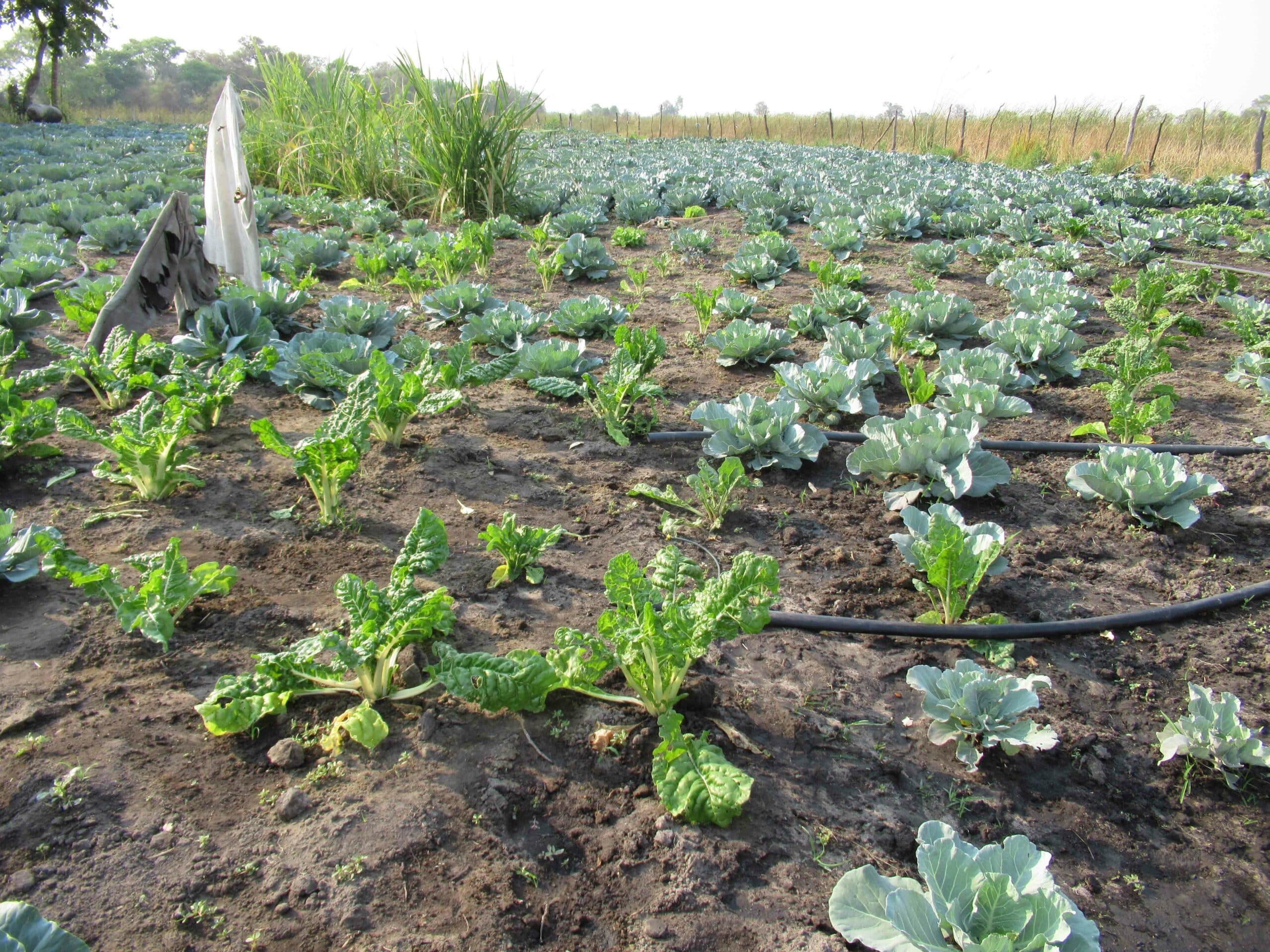
New Publication: How Demonstration Plots Shape Agricultural Futures
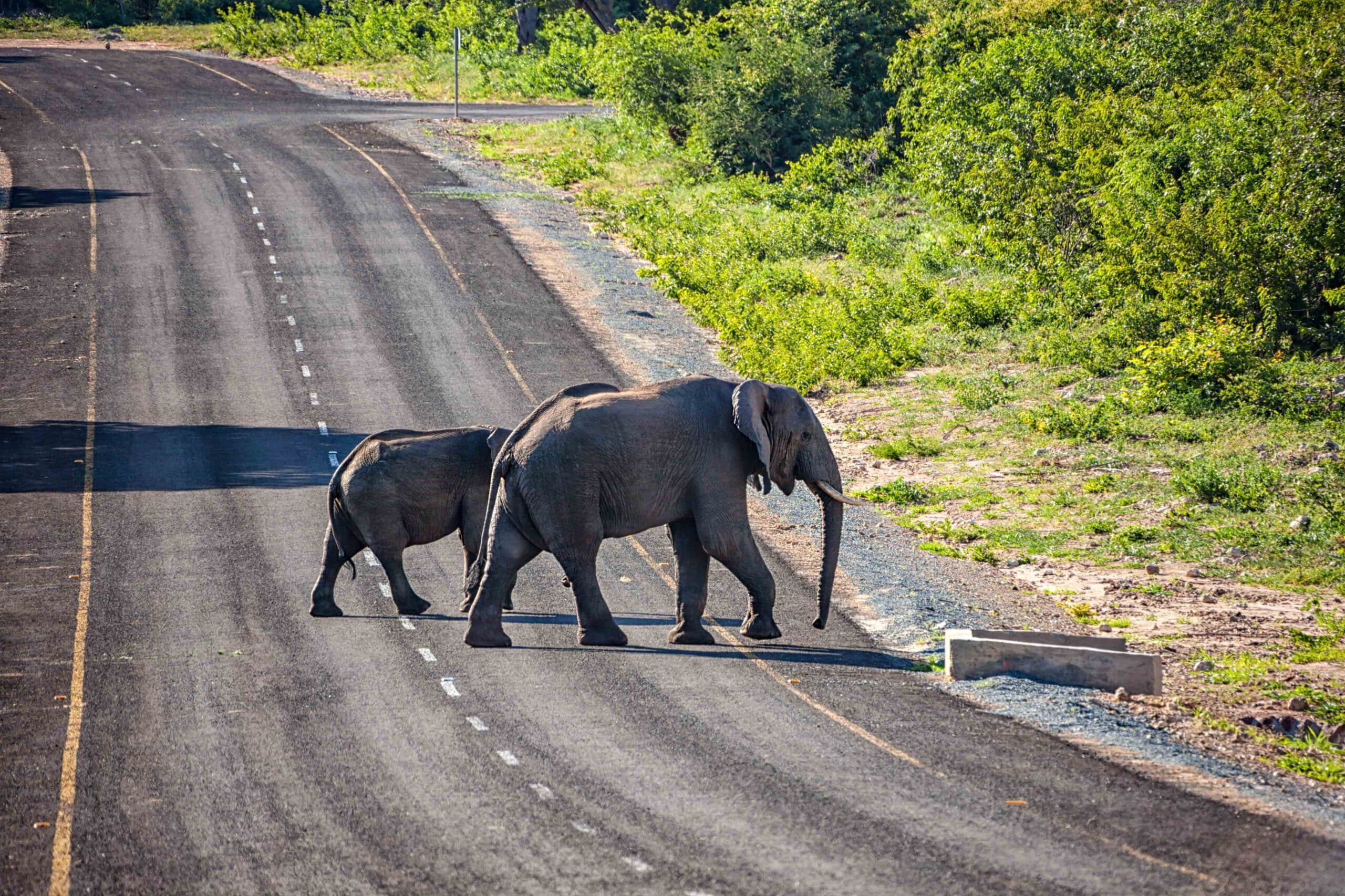
New Publication Examines How Different Stakeholders Value Wildlife in Namibia’s Coexistence Landscapes
New Special Issue Explores Infrastructure, Labour, and Power in African Contexts