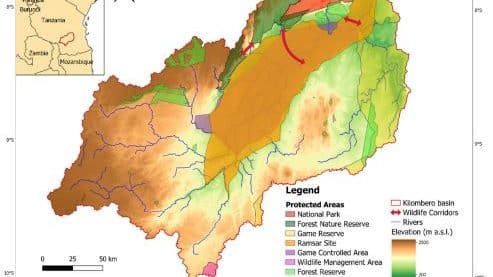
The Kilombero wetland in Tanzania is affected by advancing land use and land cover changes (LULCC), where we observe a conflict between development interests and the necessity of conservation measures to maintain the functionalities of the ecosystem. Thus, assessing patterns of LULCC is crucial to foresee potential future developments and to develop sustainable future management strategies. In this study, we use a multi-method scenario approach to assess the spatial implications and underlying driving forces of potential change by (1) developing a System Dynamics Causal Loop Diagram (CLD) to disentangle the underlying socio-economic and ecologic driving forces, (2) deriving a qualitative business-as-usual (BAU) and a conservation scenario from participatory narratives elaborated during a stakeholder workshop, and (3) quantifying the spatial implications of these scenarios with the Land Change Modeler (LCM). Results indicate that under the BAU assumption only 37% of the natural vegetation is expected to persist until 2030 in the wetland. In contrast, strict enforcement of protected areas (conservation scenario) halts further conversion of the wetland. However, both scenarios pinpoint considerable expansions of cropland in the western highlands with potentially serious impacts on catchment-wide hydrological processes. The produced qualitative and quantitative outputs reveal hotspots of possible future change and starting points for advisable further research and management interventions.
Proswitz, K., Edward, M. C., Evers, M., Mombo, F., Mpwaga, A., Näschen, K., Sesabo, J., Höllermann, B. (2021): Complex Socio-Ecological Systems: Translating Narratives in the Kilombero Catchment, Tanzania. Sustainability 2021, 13, 6552. DOI