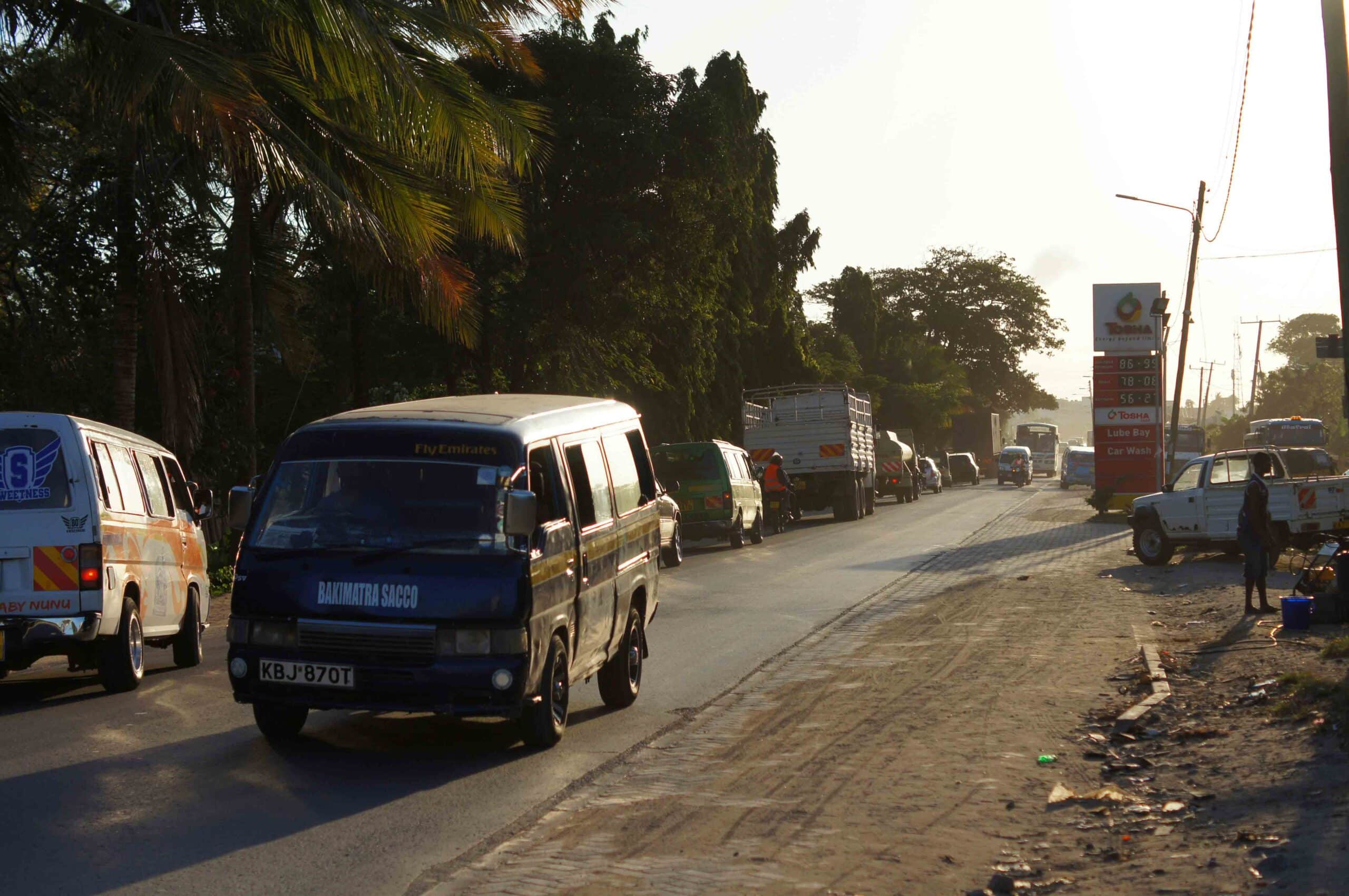
This study, conducted by researchers from our sub-project A05 “Future Roads”, examines how improved road infrastructure affects local economic development in Kenya. Using data from 2002–2022, it investigates whether reduced travel times to urban centres lead to increased economic activity. The findings suggest that better road accessibility generally boosts local economic activity over time, but the benefits are unevenly distributed. Agriculturally productive and less marginalized regions benefit more, while historically marginalized areas see more limited gains.
Road Accessibility and Local Economic Development: Evidence from two Decades of Network Expansion in Kenya
By Vincent Moseti, Philipo Mtweve, Jan Börner, Lisa Biber-Freudenberger
Abstract
Limited road accessibility remains a major constraint to socioeconomic development in remote and low-income regions. While substantial investments have been made in transport infrastructure to address this challenge, we still know little about how the economic effects of road investments evolve across space and over time. Limited data on infrastructure interventions and local economic outcomes often hinder rigorous impact evaluations. This study addresses these challenges by combining recent advances in causal inference and geospatial analysis. Using Kenya as a case study, we construct a panel spanning 2002–2022 using time-series road network data to estimate travel time to the nearest urban centers and how it changed over time. We link these measures to high-resolution proxies of economic activity, including gridded gross domestic product (GDP) and nighttime lights (NTL), and estimate causal effects using a heterogeneity-robust difference-in-differences framework. Results suggest that reductions in travel time are associated with positive changes in local economic activity that accumulate over time. However, impacts are spatially uneven, with stronger responses in agriculturally productive and non-marginalized regions and more limited effects in historically marginalized areas. Comparing accessibility measures derived from the full road network and from paved roads alone indicates no statistically significant difference in estimated GDP effects. Overall, the study advances transport geography by demonstrating how dynamic changes in accessibility shape spatially uneven development outcomes.
Reference
Moseti, V., Mtweve, P., Börner, J., Biber-Freudenberger, L. 2027. Road accessibility and local economic development: Evidence from two decades of network expansion in Kenya. Journal of Transport Geography, Volume 138 (104900), DOI