By Marie Müller-Koné, Project B03 “Violent Futures”
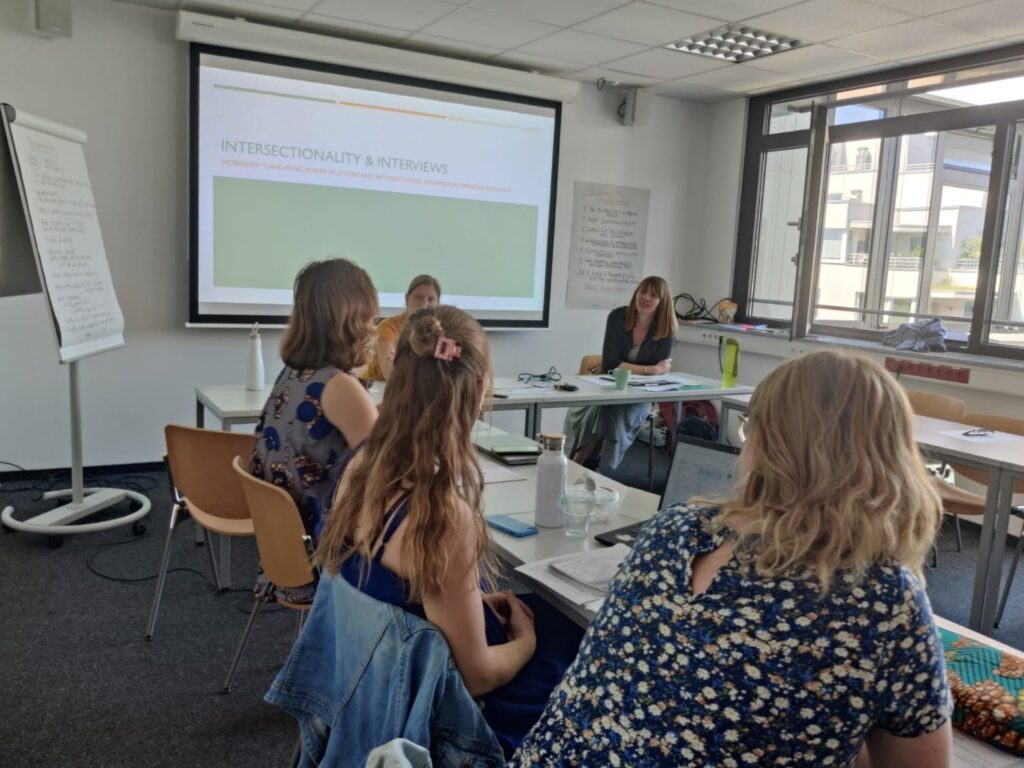
In June 2025, the workshop “Navigating Power Relations and Intersectional Dynamics in Empirical Research”, led by antidiscrimination expert Manon Diederich (subVision) and Dr. Sinah Kloß, researcher at the Bonn Center for Dependency and Slavery Studies at the University of Bonn, brought together doctoral and postdoctoral researchers from the Collaborative Research Centre (CRC) Future Rural Africa for two days of intense reflection and discussion. The event was organised by the CRC`s Board for Gender Equality and Diversity. The workshop’s aim was to focus on the specific challenges of qualitative empirical research and approach it as a gendered and embodied practice. Participants discussed and reflected on topics such as dynamic power relations, vulnerability and the agency of researchers, as well as interlocutors and gatekeepers to better prepare them for research and to provide a space to share and reflect on their experiences.
The workshop provided a “brave” space to reflect upon and discuss how emotions, one’s own identity, power relations and incidences of sexual harassment or other forms of violence affect the empirical research experience and research results. It thereby addressed a gap in academic training and teaching, as too little attention is paid to the significance of the researchers’ and the interlocutors’ intersectional identities and the impact they have on the research process.
The power relations and intersectional identities addressed at the workshop extended from hierarchies in the field and at universities to queerness of the researcher or interlocutors. Participants discussed how aspects such as the gender, age or sexual orientation of the researcher and the power relations they are embedded in, affect the research process and results. They also reflected on their personal experiences, when conducting interviews and participant observation, and developing close relationships with interlocutors (“establish rapport”) in order to acquire relevant data for research.
One difficulty of preventing and dealing with sexual(ised) harassment in a new social environment is the uncertainty about a certain behaviour being deviating or locally acceptable. The workshop usefully combined theoretical learning about the complexities of multilayered, intersectional identities with practical reflections on how to prepare oneself for the challenges during empirical research, starting with counseling services at the student offices of the Universities of Bonn and Cologne, building a support network during phases of research, and familiarizing oneself with local norms and customs.
The in-person format and the timing at the beginning of the project’s funding phase allowed for an open atmosphere to discuss the challenges researchers may face during the empirical research process. The combination of postdoctoral researchers and doctoral researchers who were starting their PhD studies among the workshop participants made for a fruitful exchange of knowledge and experiences. The workshop helped prepare participants for some of the potential challenging moments in empirical research and offered avenues for preventing and addressing them, which made for a highly valuable workshop for the overall consortium undertaking.
Reference
Kloß, S. T. (2017). Sexual(ized) harassment and ethnographic fieldwork: A silenced aspect of social research. Ethnography, 18(3), 396-414. DOI