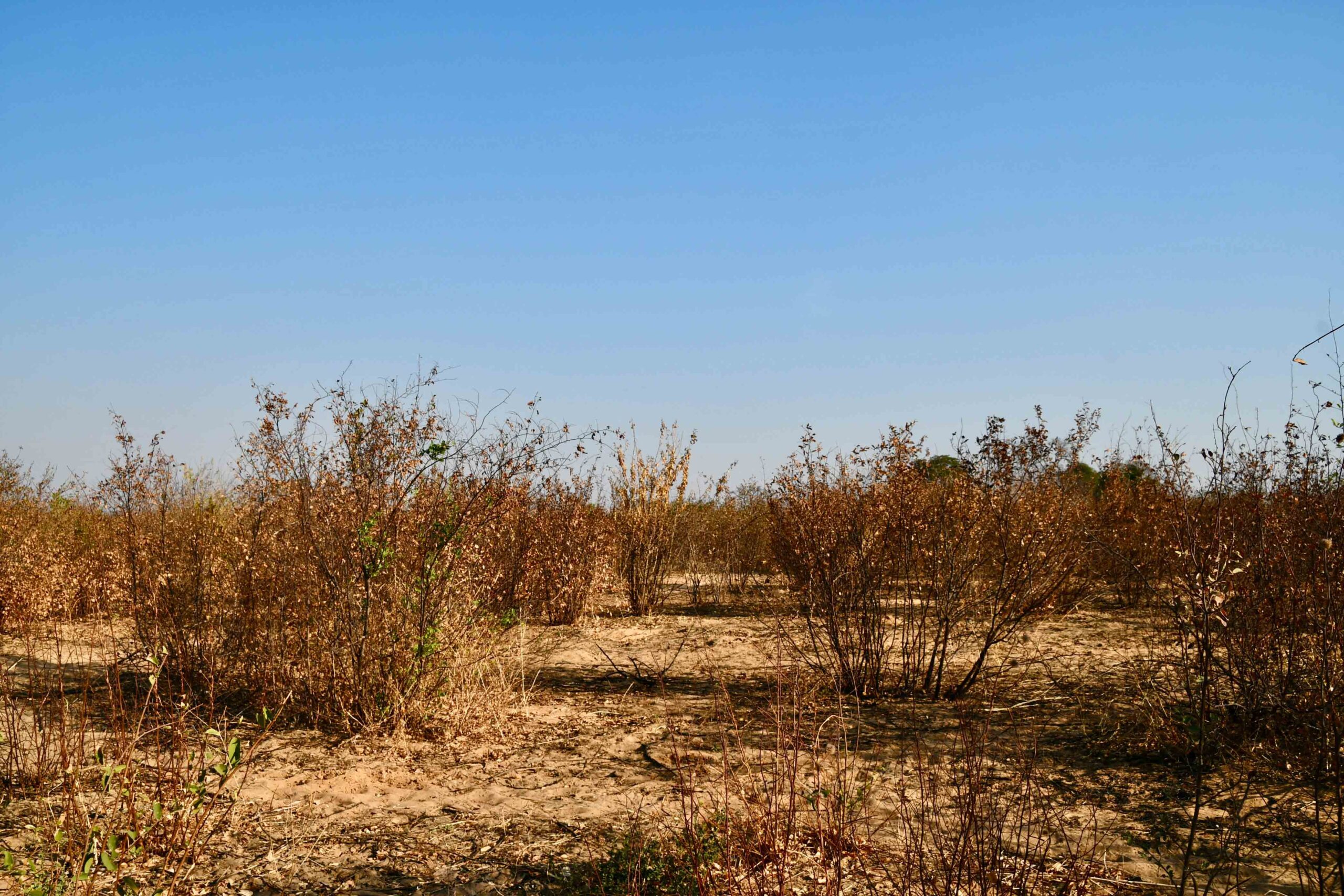
Almost one-third of global drylands are open forests and savannas, which are typically shaped by frequent natural disturbances such as wildfire and herbivory. Studies on ecosystem functions and services of woody vegetation require robust estimates of aboveground biomass (AGB). However, most methods have been developed for comparatively undisturbed forest ecosystems. As they are not tailored to accurately quantify AGB of small and irregular growth forms, their application on these growth forms may lead to unreliable or even biased AGB estimates in disturbance-prone dryland ecosystems. Moreover, these methods cannot quantify AGB losses caused by disturbance agents. Here we propose a methodology to estimate individual- and stand-level woody AGB in disturbance-prone ecosystems. It consists of flexible field sampling routines and estimation workflows for six growth classes, delineated by size and damage criteria. It also comprises a detailed damage assessment, harnessing the ecological archive of woody growth for past disturbances.
Based on large inventories collected along steep gradients of elephant disturbances in African dryland ecosystems, we compared the AGB estimates generated with our proposed method against estimates from a less adapted forest inventory method. We evaluated the necessary stepwise procedures of method adaptation and analysed each step’s effect on stand-level AGB estimation. We further explored additional advantages of our proposed method with regard to disturbance impact quantification. Results indicate that a majority of growth forms and individuals in savanna vegetation could only be assessed if methods of AGB estimation were adapted to the conditions of a disturbance-prone ecosystem. Furthermore, our damage assessment demonstrated that one-third to half of all woody AGB was lost to disturbances. Consequently, less adapted methods may be insufficient and are likely to render inaccurate AGB estimations.
Our proposed method has the potential to accurately quantify woody AGB in disturbance-prone ecosystems, as well as AGB losses. Our method is more time-consuming than conventional allometric approaches, yet it can cover sufficient areas within reasonable timespans, and can also be easily adapted to alternative sampling schemes.
Kindermann, L, Dobler, M, Niedeggen, D, Linstädter, A 2022, ‘A new protocol for estimation of woody aboveground biomass in disturbance-prone ecosystems’, Ecological Indicators, vol 135, no. 108466 DOI.