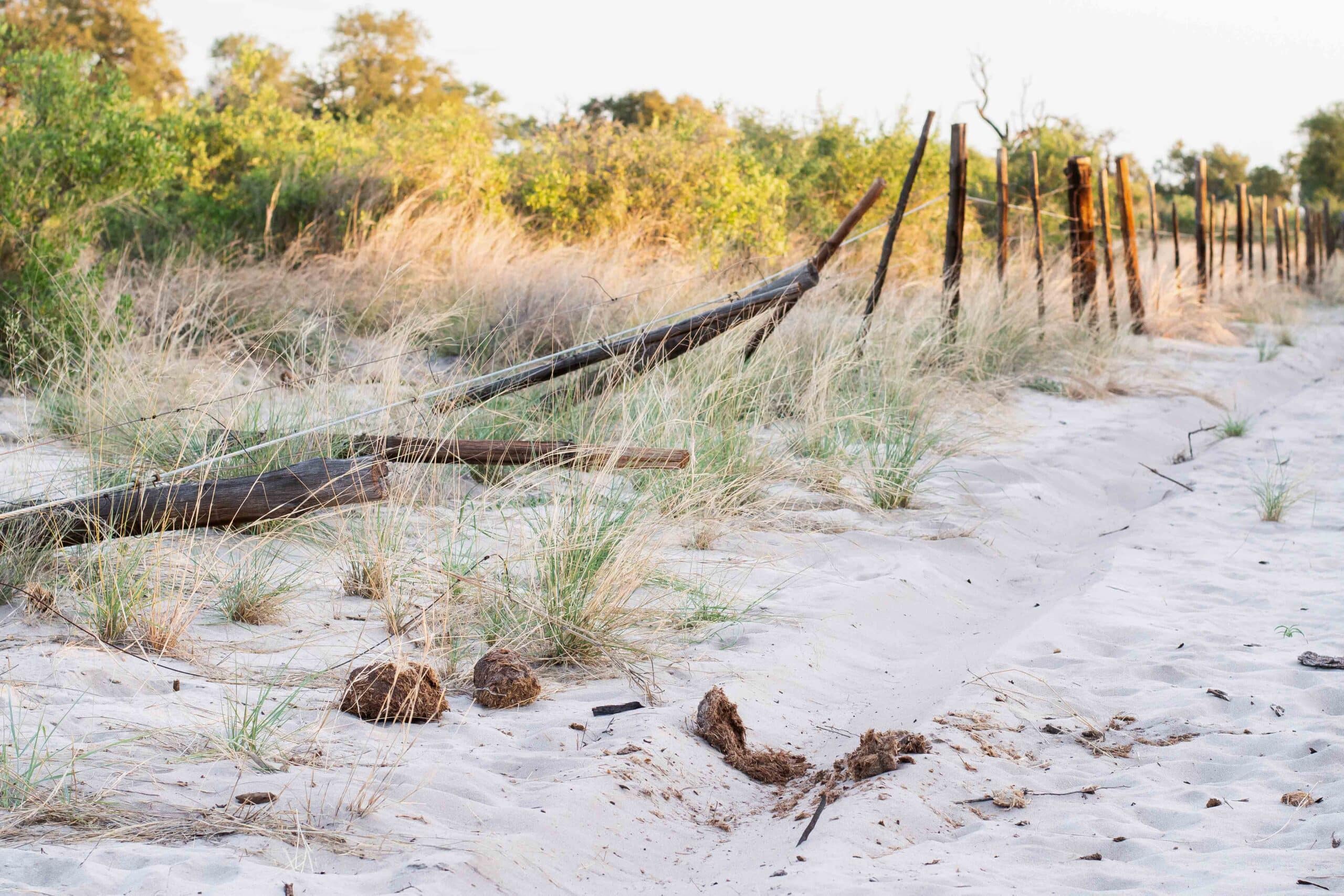
What if infrastructure does not simply fail, but changes through its interactions with the more-than-human world? In their new paper, Wisse Van Engelen and Michael Bollig from our sub-project A04, “Future Conservation”, alongside Sandra Calkins, Esther Turnhout, and Andreas Weber, examine a 240-kilometre-long wildlife fence in northern Botswana. The fence is repeatedly broken by elephants as they create pathways through it. Rather than understanding these breaks as failures, the authors interpret them as forms of “counter-infrastructuring” through which elephants actively reshape the landscape and negotiate with human efforts to order it.
Porous Fences and Elephant Agencies: Rethinking Infrastructure in the Okavango Delta
By Wisse Van Engelen, Sandra Calkins, Esther Turnhout, Michael Bollig and Andreas Weber
Abstract
Despite a recent surge of literature on infrastructure and space, infrastructure breakdown in many domains continues to be presented as the result of technical failure, neglect of maintenance, or human sabotage. Infrastructure breakdown is thus mostly cast as abnormal and as caused by deficient materials, lacking resources or disobedient humans, reproducing normative ideas that successful infrastructure should be stable in its environment and work according to its initial designs. In this paper, we challenge this modernist understanding of infrastructure. Drawing on more-than-human and postcolonial geographies, we present a case study of a 240-kilometre-long wildlife fence that was erected in the Okavango Delta in northern Botswana and that is seasonally being broken by elephants. As elephants construct their pathways across the fence, we show that the fence breakdown is part of an interspecies negotiation over how to order the landscape. We understand this dynamic as elephant counter-infrastructuring and examine varied, partial, and ambivalent responses to elephant activities. When we foreground perspectives from Botswana in this way, we no longer see a stable and fixed infrastructure that fails to work according to its blueprints, but an open-ended infrastructure that succeeds in accommodating multiple, conflicting demands and interests. Counterintuitively, we thus argue for the virtues of a porous fence as an infrastructural compromise forged in the midst of fraught political, and more-than-human negotiations over this landscape.
Reference
Van Engelen, W., Calkins, S., Turnhout, E., Bollig, M., & Weber, A. 2026. Porous Fences and Elephant Agencies: Rethinking Infrastructure in the Okavango Delta. Environment and Planning E: Nature and Space, 0(0). DOI