Publication: Aspiration formation and ecological shocks in rural Kenya

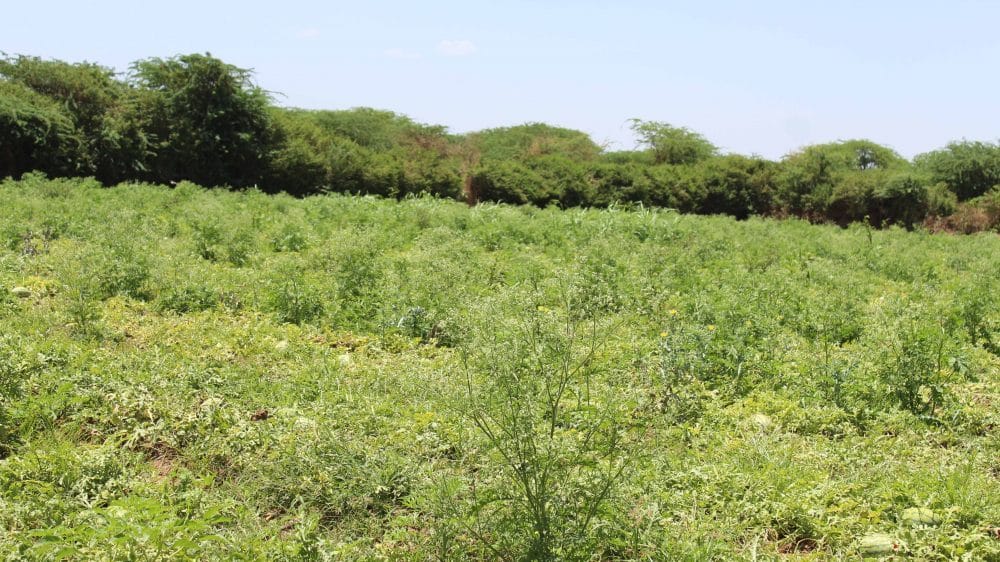
Aspirations have been shown to affect households’ decisions around productive investments, but little work explores how aspirations are formed or eroded, especially in the face of ecological threats. While ecological threats may erode social and economic capital, there is no consensus on their effect on internal factors such as aspirations. We use the spread of three invasive species as our measure of ecological stressors and shocks. While all three reduce productivity, two of these invasives are slow-moving, and one fast: Parthenium, Prosopis, and Fall Armyworm (FAW), respectively. We ask how exposure to these stressors and shocks affect aspirations about income, assets, livestock, social status, and education as well as an aspirations index. Employing primary data on 530 smallholder households in northern Kenya, we find that ecological stressors, specifically, Prosopis, are correlated with lower aspirations. The effect of ecological stressors on wealth is the mechanism through which this happens. Our findings offer suggestive evidence of the concept of the ‘capacity to aspire’ which hinges on one’s material endowment and relates to the future-oriented logic of development.

Tabe-Ojong MP, Heckelei T, Baylis K, 2021, ‘Aspiration formation and ecological shocks in Rural Kenya. The European Journal of Development Research. (Online First Articles). DOI

More CRC News

cover for a web post

Call for Contributions: Innovation and New Technologies in Agrifood Value Chains Under Pressure (Edited Volume)

The edited volume Innovation and New Technologies in Agrifood Value Chains under Pressure, planned for publishing within the Springer Book series Economic Geography, is co-authored ...
Read More »
background: landscape with zebras in front: title and authors of academic publication

Rewilding and Power: Conservation Politics in the Kavango-Zambezi Transfrontier Region

In this article, Léa Lacan and Johannes Dittman, associated reseachers from our sub-projects A04 “Future Conservation” and C03 “Green Futures”, examine rewilding in the Kavango-Zambezi ...
Read More »
cover for a web post

Epistemic Voids: A New Lens on Knowledge and Future-Making

Saymore Ngonidzashe Kativu and Anna-Katharina Hornidge (Project B05 “Science Futures”) introduce the concept of epistemic voids to explain how structural absences in knowledge systems shape ...
Read More »

Call for Panels: European Conference of African Studies (ECAS) 2027 in Lisbon

As Europe’s largest and most international conference with an African focus, ECAS2027 – the 11th European Conference of African Studies – will be held as a face-to-face ...
Read More »

New Publication: How Demonstration Plots Shape Agricultural Futures

In this study, Saymore Ngonidzashe Kativu, Javier Revilla-Diez and Anna-Katharina Hornidge, researchers from our sub-projects B05 “Science Futures” and C01 “Future in Chains”, argue that demonstration ...
Read More »
Scroll to Top