CRC TRR 228 Project B06
Digital Agrarian Futures
The political economy of the implementation of new technologies
B06 Digital Agrarian Futures
Vision
To understand and explain the current unfolding of digital agrarian futures and their politics. To contribute with our academic findings to international decision-makers and the broader society.
Project Summary
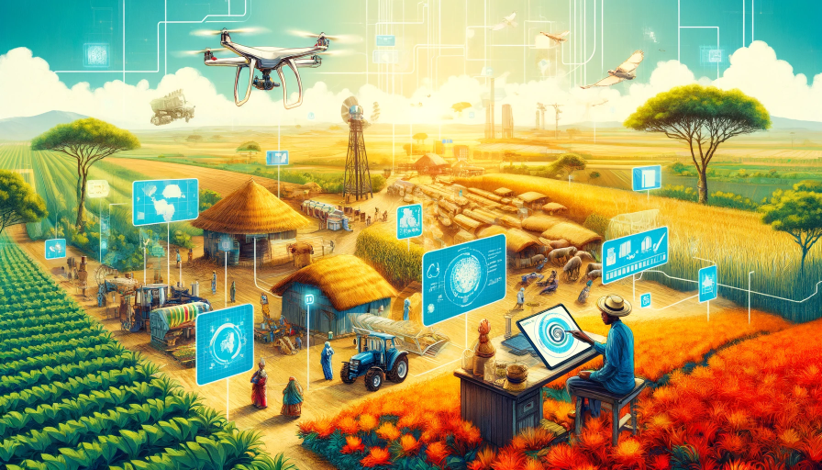
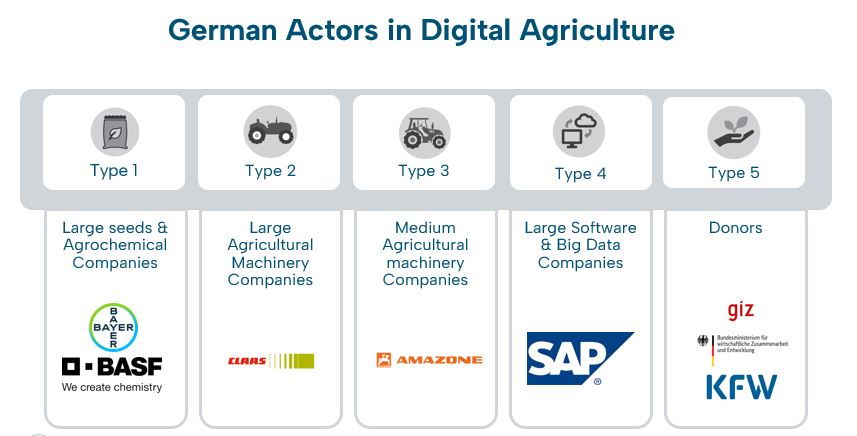
Digitalization is one of the key drivers of future-making worldwide and the basis for many utopian and dystopian visions in Africa. The digital revolution in global agriculture has begun, and it is largely driven by international companies including large agricultural businesses, multinational software and big-data companies, but also by international donors and local start-up companies. In rural areas, we are currently seeing the implementation of a variety of digital tools, ranging from applications to test the creditworthiness of smallholder farmers, to precision agriculture and decision-support tools at farm level, and online marketplaces. Already, its proponents present digitalization as the solution to achieving food security and other sustainable development goals. This optimistic vision contrasts sharply with a more critical view of the impacts of the digital revolution. Critiques emphasize the danger of an expansion of corporate power through digitalization, disemployment effects, and the loss of farmers’ autonomy and knowledge. While the interpretations and visions linked to these technologies sharply diverge between a climate-smart utopia and a corporate-controlled, data- and machine-centred, industrialized food-system dystopia, empirical studies on the actual social and ecological impacts of these technologies in the global South and particularly in Africa are still missing, and older studies are getting rapidly overtaken by new developments. The project therefore seeks to analyse, explain and evaluate current digital-tech developments in African agriculture and close the gap within the CRC since the end of project C04 (Smart Futures) after the first phase. We identify digitalization as an important element of future-making. Digital and smart technologies are a way of ordering and making legible agrarian systems. Our study will pick up on elements of prior CRC work in C04, moving beyond the “ICT4D” frame, to address digitalization involving big data, artificial intelligence, and precision farming through the “internet of things”. To understand the current unfolding of digital agrarian futures and their politics, our objectives in this project are to analyse and explain the related financialization and data ownership, labour and class, gender and generational relations as well as corporate power and food-system transformation. Beyond this analytical and explanatory approach, we want to contribute with our academic findings to international decision-makers and the broader society via international policy-dialogue activities and organize the planned CRC policy-dialogue forum in Namibia. Digitalization is strongly associated with higher-value crops, with export crops, and with horticulture more than other sub-sectors of agriculture. We therefore propose a study across horticultural sectors in two countries, which will allow for comparison of different structures of agrarian production relations, food systems, digital infrastructures and policy environments. An important element of our study is to study value-chain linkages through the digital ecosystem, from sites of digital deployment to digital development. Here we will build on results of C04, which identified problematic attempts by European companies (e.g. in Morogoro) to capture capital and data via investments in digital agriculture.
Problem Statement
Digitalization is a key driver of future-making worldwide, including agricultural value chains. B06 seeks to analyze, explain and evaluate current digital-tech developments in African agriculture and their impacts on the effected businesses, households and the broader society. Here, the project also aims to contribute with our academic findings to national and international decision-makers.
Key Questions for 3rd Phase
- Drivers: What and who drives digitalization of food systems in rural Africa (e.g. different businesses and policies)?
- Intervening variables: Which factors contribute to the adoption of or resistance to digital technologies for food production, distribution and consumption (e.g. policy environment, agrarian structure, infrastructure for tech, agency and response)?
- Outcomes: What are the outcomes of digitalization on the food system? What are the implications
for farmers and (farm and food) workers? Can digitalization contribute to a just
and socio-ecological transformation of food systems? And if so, how? How does digitalization reshape labour markets and labour power, including class, gender, migrants etc? How are young people implicated and responding? What aspects of current food systems does digitalization stabilize? Which aspects does it change or even disrupt? To what degree can we see challenges of data ownership or data grabbing?
Provisional Hypotheses
- Digitalization in African agriculture is a means by which corporate power is being extended within African food systems.
- Digitalization is driven by financial-sector actors seeking to expand their client base via non-traditional methods (using different market-entry strategies depending on their different interests, capabilities and influences including their role and influence within the value chain).
- Digitalization changes the nature and extent of labour demand, and introduces forms of labour control and surveillance, which contribute to the restructuring of agrarian class relations.
- The impacts of digitalization are highly diverse, and contingent on the governance, regulation and ownership regimes in place.
- Digitalization produces differentiated social outcomes which interact with, and can either accentuate or mitigate, the class, gender and generational dimensions of inequality.
- Development interventions by African states, international agencies, and private- and nonprofit-sector actors can shape the outcomes of digitalization for agrarian change.
Methods
Mixed method approach based on Interviews, document analysis, participant observation, analysis of survey results
Cooperation within the CRC
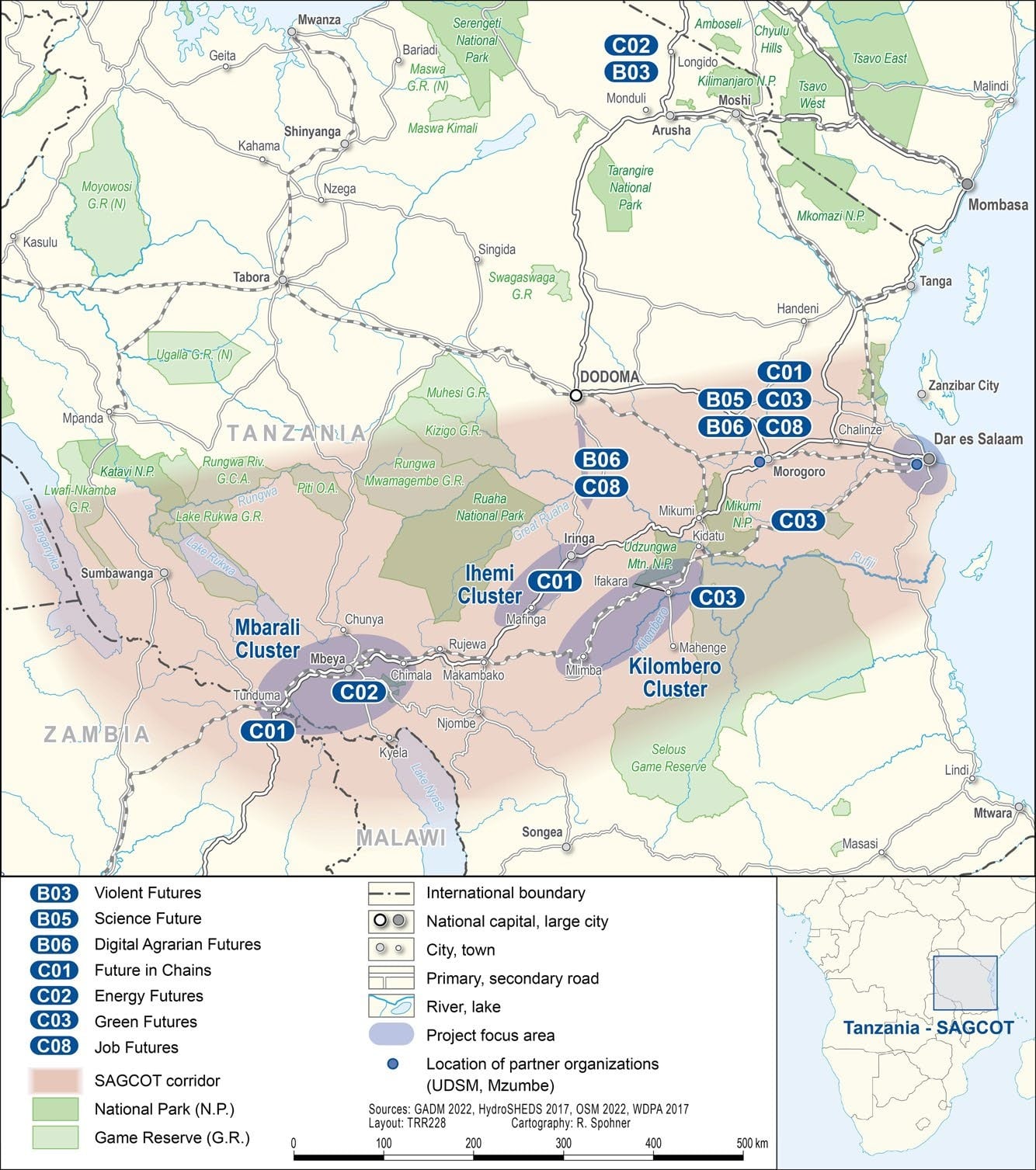
With C01 on developments in agricultural value-chains and role of non-farm actors (in particular large foreign actors). Further with C01 and B03 at the interface of agriculture, rural livelihoods and infrastructure. With C02 and C08 on the role of digital activities on rural households and on rural-jobs creation. Contribution to survey (Z03) focusing on digitalization and supporting data collection in Kenya and Tanzania, the exhibition project (Z05) and CRC228 policy-dialogue activities.
Project-and subject-related list of publications
ACB (African Centre for Biodiversity) 2023. The rise of digital agriculture and dispossession in Africa: the implications for smallholder farmers. Briefing paper, August 2023. Johannesburg.
Barrientos, S. 2019. Gender and Work in Global Value Chains: Capturing the Gains? Cambridge: Cambridge University Press. DOI
Birner, R., Daum, T. and Pray, C. 2021. ‘Who drives the digital revolution in agriculture? A review of supply-side trends, players and challenges’, Applied Economic Perspectives and Policy, 43(4), pp. 1260–1285. DOI
Bryceson, D.F. and Jamal, V. (1997) Farewell to Farms: De-Agrarianisation and Employment in Africa. London: Routledge.
Carmody, P. 2024 “Digital provide” or product consumption diffusion cycle? The diffusion impact and potential of digital technology in the Global South’, Information Technology for Development, pp. 1–14. DOI
Clapp, J. 2021. The problem with growing corporate concentration and power in the global food system, Nature Food, 2(6), pp. 404–408. DOI
Coggins, S., McCampbell M., Sharma A., Sharma R., Haefele S.M., Karki E., Hetherington J., JSmith J., and Brown B. 2022. How have smallholder farmers used digital extension tools? Developer and user voices from sub-Saharan Africa, South Asia and Southeast Asia, Global Food Security, 32, p. 100577. DOI
Dannenberg, P., Revilla Diez, J. and Schiller, D. 2018. Spaces for integration or a divide? Newgeneration growth corridors and their integration in global value chains in the Global South’, Zeitschrift für Wirtschaftsgeographie, 62(2), pp. 135–151. DOI
Daum, T. et al. 2022. Connected cows and cyber chickens? Stocktaking and case studies of digital livestock tools in Kenya and India’, Agricultural Systems, 196, p. 103353. DOI
Fairbairn, M. and Kish, Z. 2022 . A poverty of data? Exporting the digital revolution to farmers in the Global South’, in J. Goldstein and E. Nost (eds) The Nature of Data: Infrastructures, Environments, Politics. University of Nebraska Press, pp. 211–229. DOI
FAO 2020. Realizing the potential of digitalization to improve the agri-food system: Proposing a new International Digital Council for Food and Agriculture. A concept note. Rome: Food and Agriculture Organization of the United Nations.
Follmann, A., Dannenberg, P., Baur, N., Braun, B., Walther, G., Bernzen, A., Börner, J. Brüntrup, M., Franz, M., Götz, L., Hornidge, A-K., Hulke, C., Jamali Jaghdani, T., Krishnan, A., Kulke, E., Labucay, I., Nduru, G.M., Neise, T., Priyadarshini, P., Revilla Diez, J., Rütt, J., Scheller, C., Spengler, T., and Sulle, E. 2024. Conceptualizing Sustainability and Resilience in Value Chains in Times of Multiple Crises – Notes on Agri-food Chains’, Die ERDE, 155(1), pp. 29–48. DOI
Foster, L., Szilagyi K., Wairegi, A., Oguamanam C. and de Bee, J. 2023. Smart farming and artificial intelligence in East Africa: Addressing indigeneity, plants, and gender’, Smart Agricultural Technology, 3, p. 100132. DOI
Fraser, A. 2019. Land grab/data grab: precision agriculture and its new horizons’, The Journal of Peasant Studies, 46(5), pp. 893–912. DOI
Hall, R. 2023. Digital Technologies in African Agriculture: Livelihoods, Climate Change and Food System Change. Workshop report, 25-26 September 2023. Cape Town: Institute for Poverty, Land and Agrarian Studies, University of the Western Cape. Link
Hall, R., Scoones, I. and Tsikata, D. 2017. Plantations, outgrowers and commercial farming in Africa: agricultural commercialisation and implications for agrarian change’, The Journal of Peasant Studies, 44(3), pp. 515–537. DOI
Hall, R., Tsikata, D. and Scoones, I. (eds) 2015. Africa’s land rush: rural livelihoods & agrarian change. Woodbridge: James Currey.
Hartmann, G., Nduru, G. and Dannenberg, P. 2021. Digital connectivity at the upstream end of value chains: A dynamic perspective on smartphone adoption amongst horticultural smallholders in Kenya’, Competition & Change, 25(2), pp. 167–189. DOI
Heeks, R. 2008. ‘ICT4D 2.0: The Next Phase of Applying ICT for International Development’, Computer, 41(6), pp. 26-33. DOI
Jayne, T.S., Muyanga, M., Wineman, A., Ghebru, H., Stevens, C., Stickler, M., Chapoto, A., Anseeuw, W., Van der Westhuizen, D. and Nyange, D. 2019. Are medium-scale farms driving agricultural transformation in sub-Saharan Africa?’, Agricultural Economics, 50(S1), pp. 75–95. DOI
Kiaka, R.D. 2024. Digital Technology in Kenyan Agriculture: A Scoping Report. Working Paper 67. Cape Town: Institute for Poverty, Land and Agrarian Studies, University of the Western Cape. (supervised by R. Hall). Link
Klerkx, L., Jakku, E. and Labarthe, P. 2019. A review of social science on digital agriculture, smart farming and agriculture 4.0: New contributions and a future research agenda’, NJAS: Wageningen Journal of Life Sciences, 90–91(1), pp. 1–16. DOI
Koshy, N.S., Jagadeesh K., Govindan S. and Sami, N. 2021. Middlemen versus middlemen in agrifood supply chains in Bengaluru, India: Big data takes a byte’, Geoforum, 127, pp. 293–302. DOI
Krone, M. and Dannenberg, P. 2018. Analysing the effects of information and communication technologies (ICTs) on the integration of East African farmers in a value chain context’, Zeitschrift für Wirtschaftsgeographie, 62(1), pp. 65–81. DOI
Krone, M., Dannenberg, P. and Nduru, G. 2016. The use of modern information and communication technologies in smallholder agriculture: Examples from Kenya and Tanzania’, Information Development, 32(5), pp. 1503–1512. DOI
Lioutas, E.D., Charatsari C., La Rocca, G. and De Rosa, M. 2019. Key questions on the use of big data in farming: An activity theory approach’, NJAS: Wageningen Journal of Life Sciences, 90–91(1), pp. 1–12. DOI
Luxen, V. 2024. Digital Technology in Zambian Agriculture: A Scoping Report. Working Paper 66. Cape Town: Institute for Poverty, Land and Agrarian Studies, University of Western Cape (supervised by P. Dannenberg). Link
Malik, S.A. 2022. Linking climate-smart agriculture to farming as a service: mapping an emergent paradigm of datafied dispossession in India’, The Journal of Peasant Studies, 50(6), pp. 2187–2209. DOI
Matejcek, A. 2022. Das tansanische Reisfeld als lebendes Labor? Eigenlogiken des Übersetzungsprozesses einer technologiezentrierten Pilotstudie in ein
Agrarentwicklungsprojekt’, Geographica Helvetica, 77(2), pp. 239–252. DOI
Matejcek, A. and Verne, J. 2021. Mobile Applications to Secure Tenure in Rural Tanzania: Anticipating Diverging Agricultural Futures and the Production of (In)securities in the Kilombero Valley, Culture Unbound, 13(3), pp. 45–69. DOI
Mbunda, R. 2016. The Developmental State and Food Sovereignty in Tanzania’, Agrarian South: Journal of Political Economy: A triannual Journal of Agrarian South Network and CARES, 5(2–3), pp. 265–291. DOI
McMichael, P. 2014. Food regimes and agrarian questions. Halifax: Practical Action Publishing (Agrarian change and peasant studies, 3).
Nalwimba, N. 2024. Digital Technology in Zambian Agriculture: The Case of German Actors. Working Paper 68. Cape Town: Institute for Poverty, Land and Agrarian Studies, University of the Western Cape. (supervised by R. Hall). Link
Ouma, S. 2024. Accounting for Capital in the Countryside: Toward a Visual Politics of the Asset Form’, The Professional Geographer, 76(6), pp. 805–813. DOI
Ouma, S., Stenmanns, J. and Verne, J. 2019. in M. Graham (ed.) Digital Economies at Global Margins. Cambridge: MIT Press, pp. 341–364.
Prause, L. 2025. The farm as digital factory: controlling labour and nature in digital agriculture’, The Journal of Peasant Studies, pp. 1–19. DOI
Prause, L., Hackfort, S. and Lindgren, M. 2021. Digitalization and the third food regime’, Agriculture and Human Values, 38(3), pp. 641–655. DOI
Pye, O. 2021. Agrarian Marxism and the proletariat: a palm oil manifesto’, The Journal of Peasant Studies, 48(4), pp. 807–826. DOI
Rotz, S., Duncan, E., Small, M., Botschner, J., Dara, R., Mosby, I., Reed, M. and Fraser, E.D.G. 2019. The Politics of Digital Agricultural Technologies: A Preliminary Review’, Sociologia Ruralis, 59(2), pp. 203–229. DOI
Schimpf, M. 2020. Digital Farming. Can digital farming really address the systemic causes of agriculture’s impact on the environment and society, or will it entrench them? Brüssel: Friends of the Earth. Link
Stone, G.D. 2022. Surveillance agriculture and peasant autonomy, Journal of Agrarian Change, 22(3), pp. 608-631. DOI: 10.1111/joac.12470.
White, B. 2020. Agriculture and the generation problem. Halifax: Practical Action Publishing Ltd.
Wolford, W.W. et al. 2024. Global land deals: what has been done, what has changed, and what’s next?’, The Journal of Peasant Studies, pp. 1–38. DOI
Project News

Call for Applications: Two PhD Scholarships in our Project B06 “Digital Agrarian Futures”
Call for Contributions: Innovation and New Technologies in Agrifood Value Chains Under Pressure (Edited Volume)
Team Members



Prof. Dr. Ruth Hall
Project Leader
Institute for Poverty, Land and Agrarian Studies (PLAAS)